The best NovelCrafter alternatives at a glance
Every AI writing tool is different, and comparing them to NovelCrafter involves considering those differences in context to NovelCrafter’s strong capabilities as a writer assistant. Here’s a quick “at a glance” summary of each tool we looked at, and what we think of them as alternatives to NovelCrafter’s offering.
Quick Comparison:
Type.ai: We find Type to be the best tool on the market for writers who want a strong editor and a great writing flow. It removes tons of friction from the writing and editing process and keeps writers writing rather than wrestling with the environment.
Price: $8/month (billed annually)
Strengths: Document focused drafting/revision
Limitations: Lightweight “codex” and worldbuilding capabilities
Sudowrite: Sudowrite is a well-known, capable product with built-in AI tools galore. It is more focused on generation than human involvement, and sometimes gets in its own way.
Pricing: $10/month (billed annually)
Strengths: Powerful AI tools for generating novels
Limitations: Uses credits fast; Sometimes forgets to keep the writer in the loop
Scrivener: As a powerful non-AI manuscript organizer, Scrivener doesn’t have built-in AI generation at all. It’s purchased as a one-time desktop license and is powerful when working within the scope of what it’s meant to do.
Pricing: $59.99 one-time (Mac or Windows)
Strengths: Structuring, formatting, and exporting
Limitations: Not an AI-driven product
Dabble: If you want a simple plot-development tool, Dabble excels at the job. It helps users used to a more conventional novel-building process, but doesn’t provide generative AI assistance
Pricing: $19/month
Strengths: Great at a traditional plotting process and novel-drafting flow
Limitations: Dabble is not a generative AI tool.
Plottr: Plottr is a non-AI tool for creating visual timelines for story planning purposes. We found it competent and useful, but limited to the narrow band of work it tries to tackle.
Pricing: $60/year; Pro $9.99/month
Strengths: Great for planning and visualizing a plot
Limitation: Plottr is a limited tool meant for a very specific need and little else.
NovelAI: We found NovelAI to be a great tool for lighter imagining and conceptualizing work; it’s a fun enough toy environment to play around in and get your creative juices flowing
Pricing: $10/month
Strengths: Fun tools for spurring your imagination onwards
Limitations: Weaker than average models and capabilities
Obsidian: We really liked Obsidian’s core app and how it helped us create a DIY story bible with linked notes and plugins. It’s not an integrated AI novel-creation tool, but is great at what it does.
Pricing: Free core app
Strengths: Great core functionality and versatility
Limitations: Obsidian isn’t an AI tool by default
Why writers look for a NovelCrafter alternative
Writers don’t leave NovelCrafter because it's bad; if anything, our impression is that it’s a strong tool that does what it’s intended to do. Instead, when you imagine a writer leaving NovelCrafter it’s because NovelCrafter is made for a set of techy, engineer-like needs most writers just don’t have.
NovelCrafter’s biggest pitch is “bring your own key” functionality, essentially that writers can use their interface with any AI they want to plug in. This means that NovelCrafter users have a lot of choice and the possibility of saving a bit of money by using a less expensive model for certain tasks. It also means a fair amount of setup and juggling separate bills both for the tool itself and the LLM powerplants that make it run.
For some writers, this is wonderful and exactly what they need. For others, it means work to do before ever getting around to writing. The same logic applies to NovelCrafter’s “Codex” tools. If you need a way to keep characters, locations, and factions straight at an in-depth, no-stone-left-unturned level of complexity, NovelCrafter is perfect. The learning curve is real, though, and excessive if you don’t specifically need the reward it offers.
Type.ai vs NovelCrafter at a glance
Type.ai is the perfect tool for users who want their editing and writing to happen in the document itself, where they can see and approve changes inline with their text. It’s a writer’s tool meant to encourage in-depth work, not to replace the human element you provide.
NovelCrafter is similar and offers a kind of AI model choice that nobody else can match. Since both tools overlap quite a bit in terms of what they can do, we thought it would be useful to create a quick comparison table that shows which tool wins for which writer needs, and why.
The main difference is control versus convenience
It would be a mistake to think of the choice between Type.ai and NovelCrafter as being about which tool creates better prose. Broadly speaking, both tools have access to top-end, recent-release models from Anthropic and OpenAI. If you ask them to generate a paragraph or two of text, the results you get will be very similar on a prose level.
The main difference between them lies in how you want to work. Type.ai focuses on making a product for serious writers, a tool that’s as powerful as possible while not getting in the way of your creative flow. Our experience using their tool was that we could type a section in the old fashioned way, and then zig-zag to grammar checks, sentence-level refinements, and suggestions on what to do next without ever taking our focus on the words themselves.
The tools Type.ai provides to do this are both powerful and convenient in a way that blurs the lines between “writing” and “editing” and creates one slick, cohesive process.
NovelCrafter isn’t without its points, but it's a different game. Their Codex planning tools are great, but take a bit of effort to get the hang of if you want to reap their full benefit. Their interface is pretty good, too, and we found it usable and fun if not as refined as Type’s.
The real benefit to NovelCrafter is that a very knowledgeable, tech-oriented writer can use it to integrate AI models other services don’t offer. That means that for a low-weight task, they might use an open source model running on a home laptop instead of an all-powerful but token-expensive frontier model. Then they might switch back when heavy lifting was needed.
The only problem is that most writers don’t have that granularity of needs, and don’t have the knowledge to model-switch in a way that benefits them even if they do. The average author wants a full-power model working on every word, and that’s not unreasonable.
For the average writer, there’s a clear winner here. Type.ai gives access to the models most people will want and a more powerful, more usable interface that stays out of your way except when you need it. It loses out only when a writer needs, wants, and understands how to get the most out of granular, API-key based model choice.
Since those writers are rare, there’s a good chance Type.ai is the choice for you.
Starting a new novel
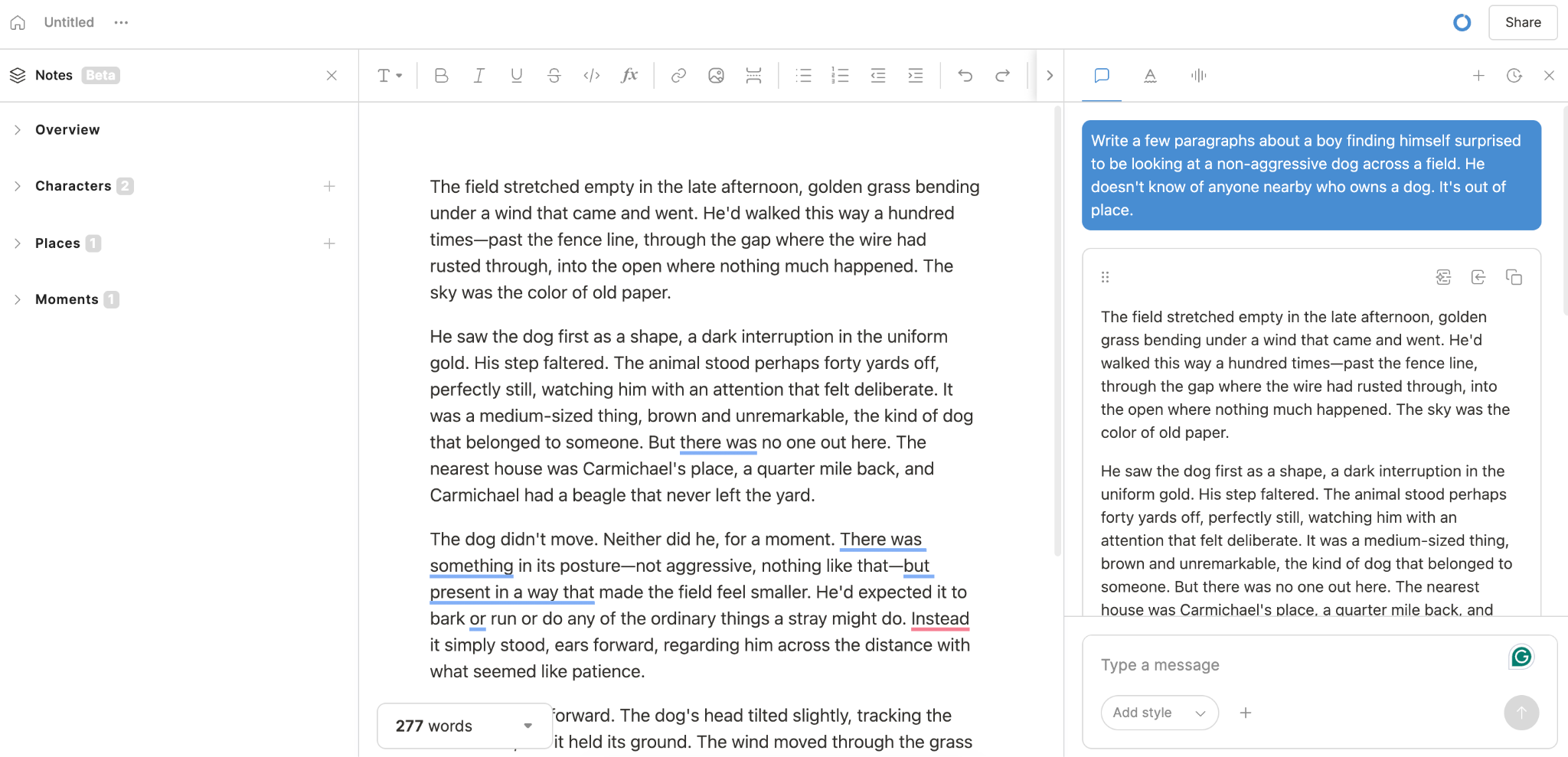
A project in Type.ai can start in any of several ways. Some writers will jump right into the writing process, putting fingers to a keyboard and words down on the page. Or they might prompt the same thing to get their creative juices flowing, as here:
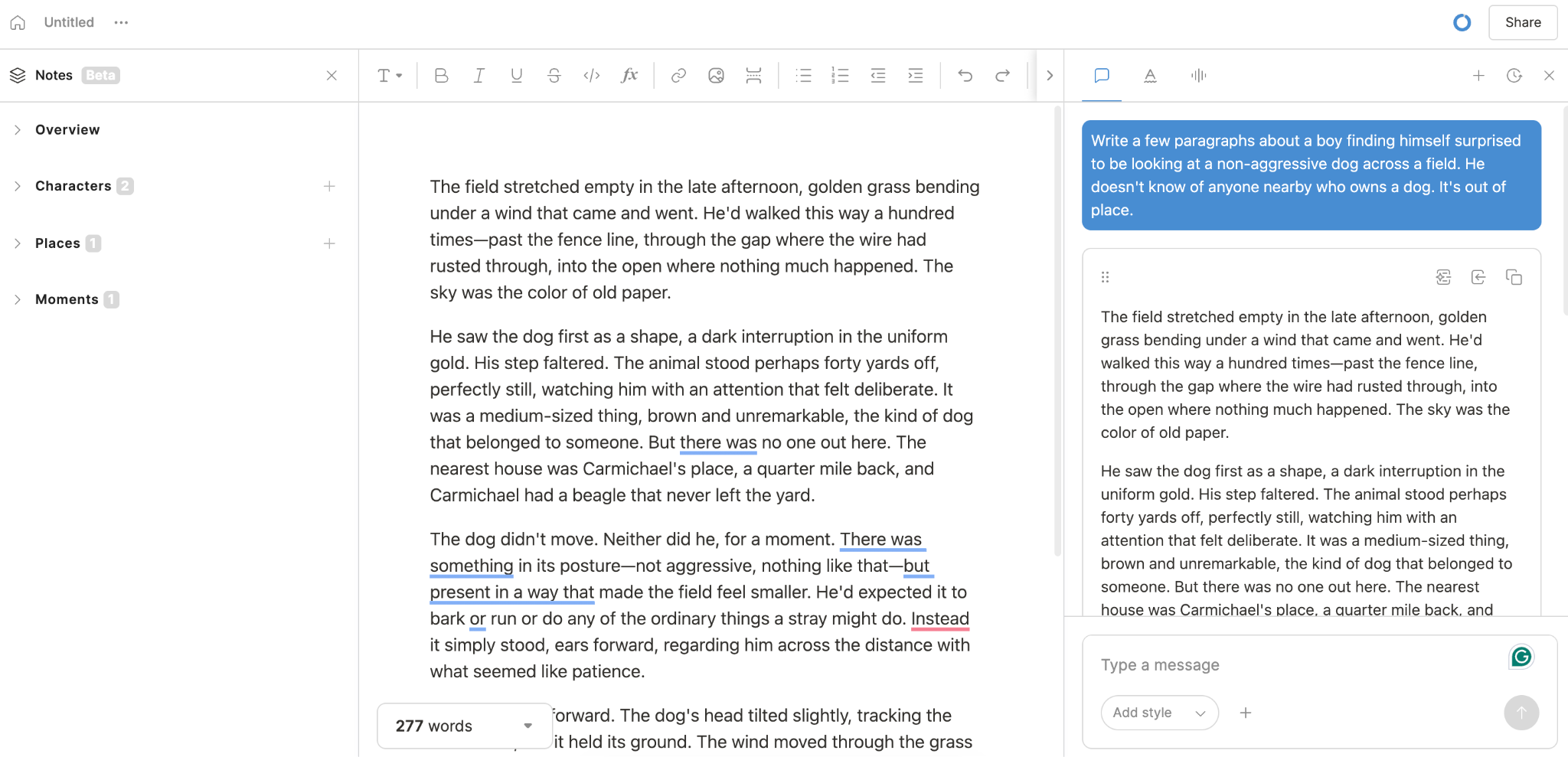
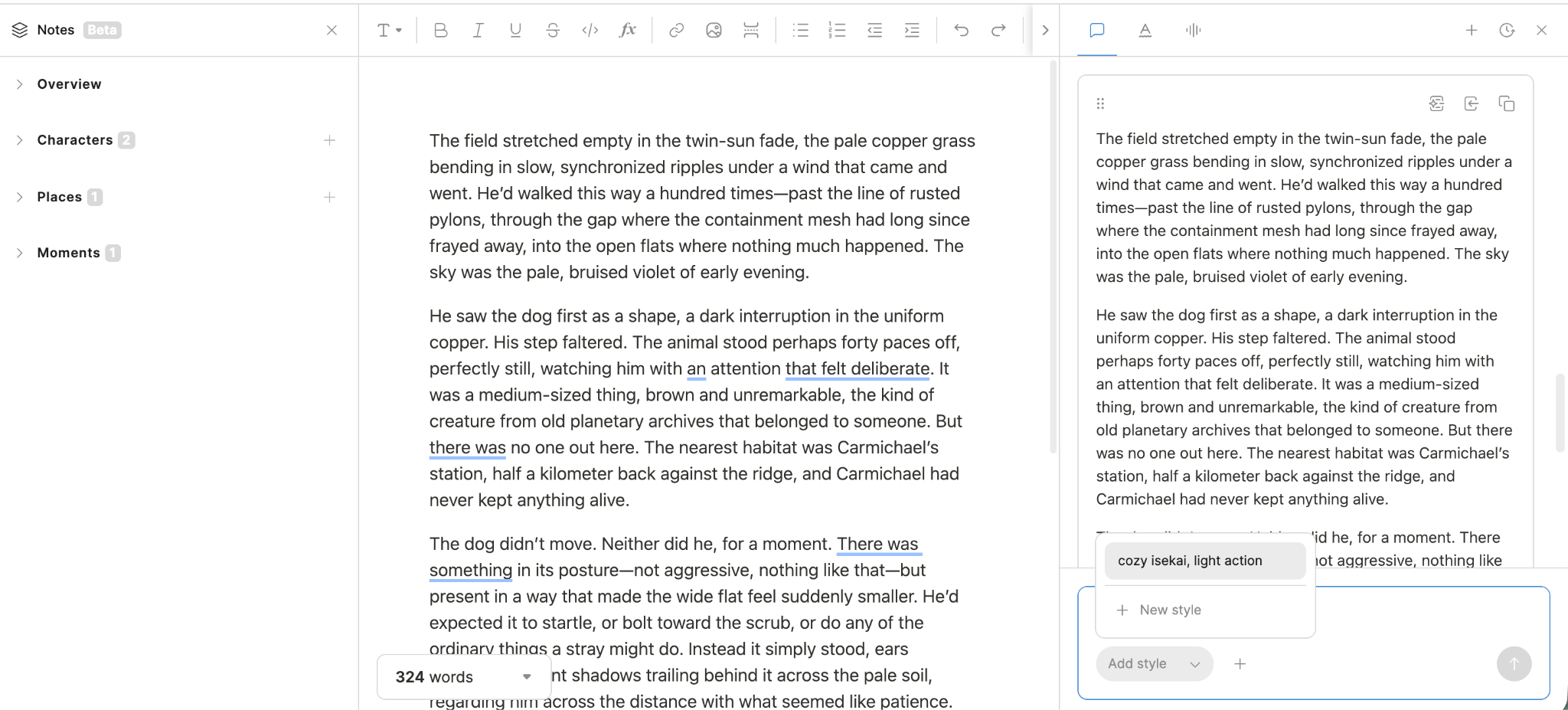
Note what else is on that same page. The automated note-taking tools have already started to learn about what characters and settings exist in the books, and have updated accordingly. The AI assistant is waiting for instructions on what kind of style the writer expects, and once those are entered will follow them to the letter.
Most importantly, every direction you go immediately puts you into the flow of creating. You are writing within seconds, and every tool you need is at your fingertips to keep things moving over, around, and through whatever hurdles are in your way.
By contrast, the first thing you have to do in NovelCrafter is subscribe to a paid tier at the “Hobbyist” level or above. Without that, it’s a simple organizational tool with no AI integrations at all, since those are only allowed on paid plans.
After that, most of NovelCrafter’s initial process guides you towards building out your novel’s structure in their Codex tool. You can start writing right away, but for planning-style writers there’s a certain shallow-but-real learning curve in getting the codex fleshed out with all the who, where, and why entries your novel runs on.
None of these differences are dealbreakers for most, but the difference is nonetheless pretty stark; by the half-hour mark with Type.ai, we had been writing for almost every second the timer had been ticking. In NovelCrafter, we had spent most of that time in set-up rather than creation, and had spent money trying it out rather than coasting along on a free tier until we knew the ropes.
Once we knew the ropes in each, we found that Type.ai’s work still went faster and more smoothly for us - that’s what it’s built for.
Story planning, worldbuilding and the Codex
NovelCrafter’s clear advantage in storybuilding shouldn’t be minimized. With the possible exception of Sudowrite, no tool encourages more deeply realized world-building than NovelCrafter.
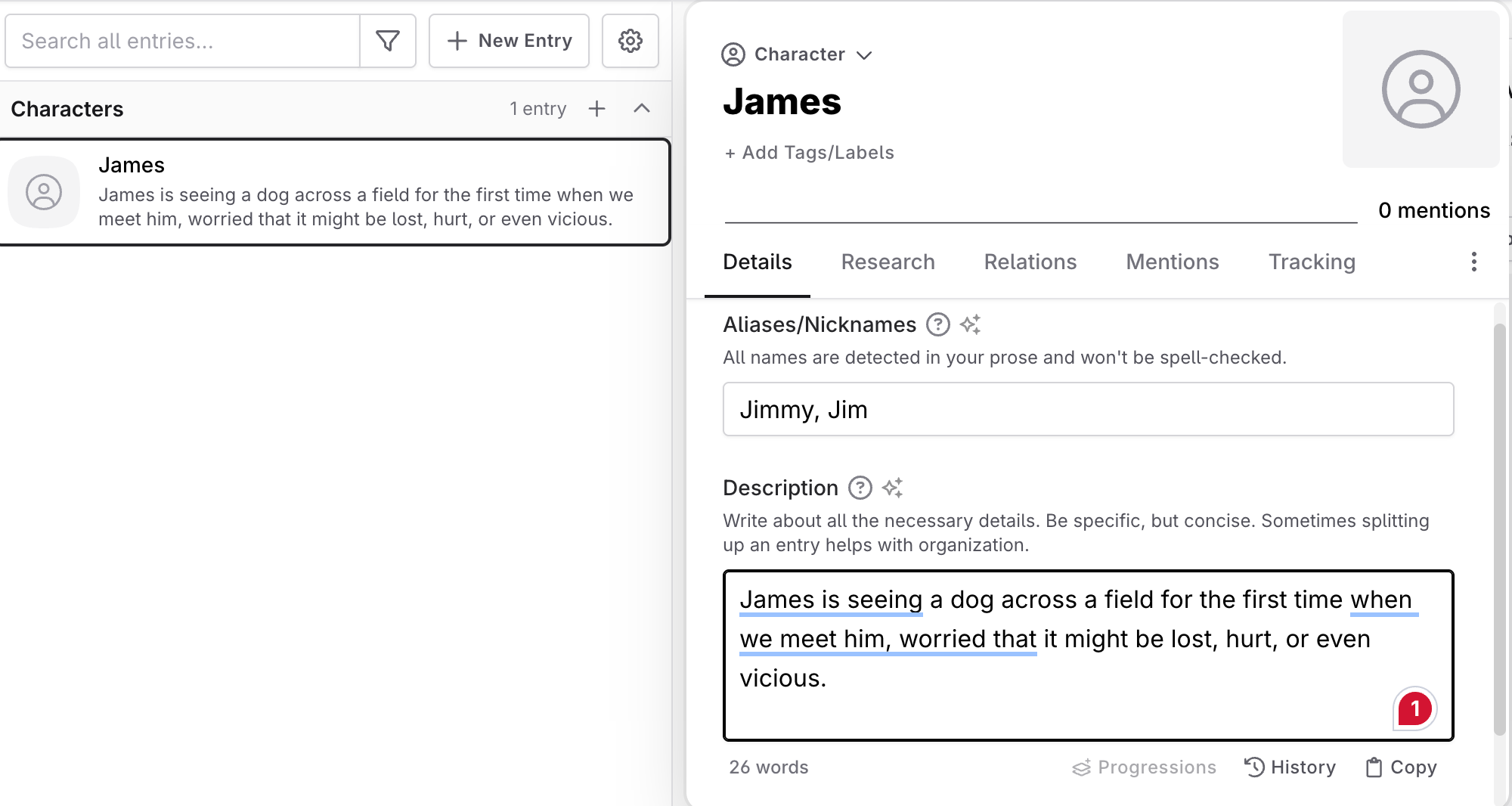
Whether it’s a piece of lore, a magical item, a location or a character, Novelcrafter has an entry type for a writer to use that not only allows them to record all the relevant details, but also lets them see where those characters occur in their novel, how they relate to other entries, and generally how they are situated in a changing story over time.
Entering all these details is a definite setup cost, but for an author writing a complex story over an entire novel or a series it’s a cost that might very well prove worth the time.
Type.ai uses a lighter-touch, more automatic system. As new characters and locations appear in the story, they automatically update into a growing, evolving database that can then be manually edited to just the facts and ideas the author wants to preserve.
NovelCrafter’s Codex is a different feature that works in a different way, and we want to be careful to note that Type.ai’s alternative does not completely replace it. If you are a heavy worldbuilder who takes extensive notes, Type’s system is adequate or even good, but not quite the equal of the capabilities of NovelCrafter’s codex just yet.
Drafting inside the manuscript
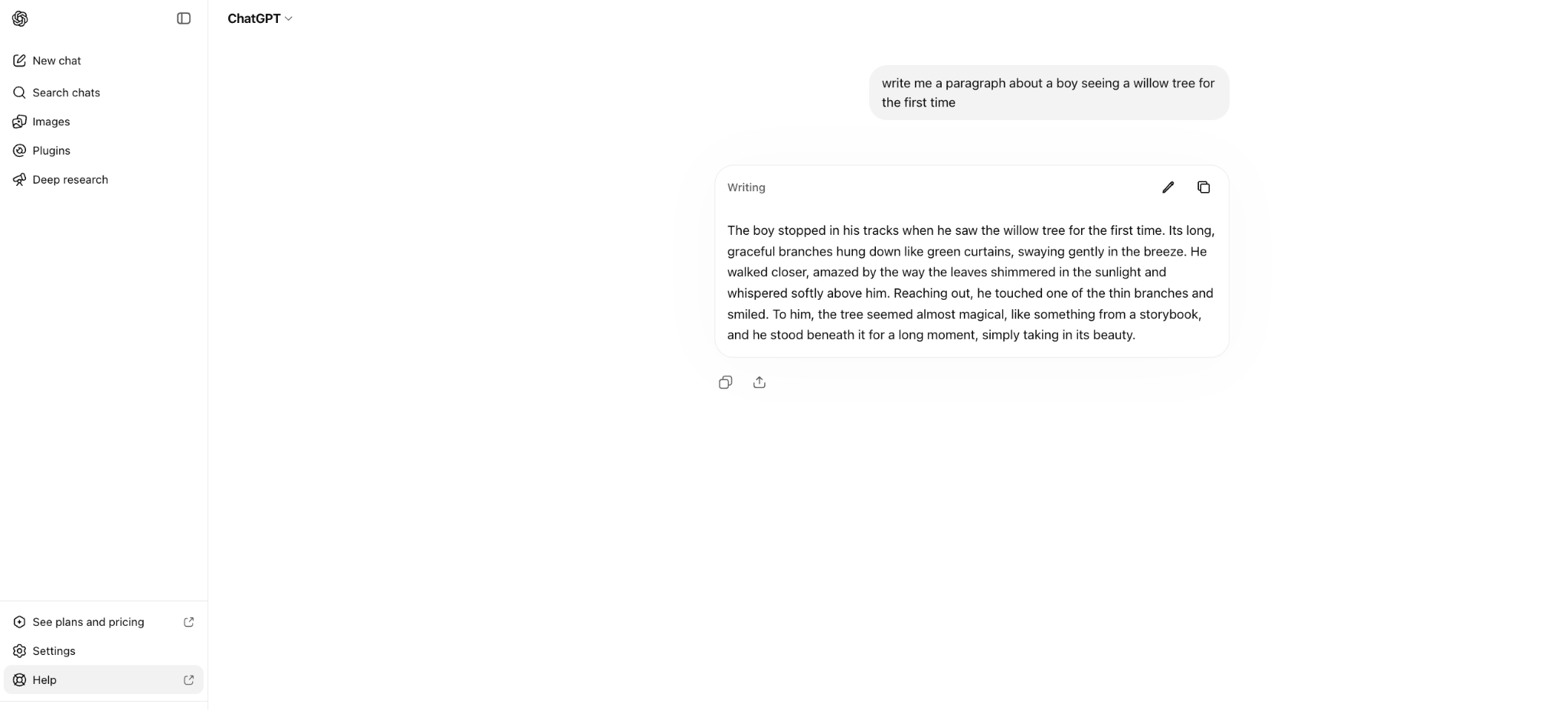
Type.ai’s strongest pitch involves what it calls a manuscript-first or document-first workflow. It’s a little hard to describe for those who haven’t experienced it, so we’ll try to give an impression with images as best we can. Earlier in the article, we showed the process of generating a few paragraphs from the first steps. The AI assistant got a prompt, proposed an entry, and we then approved it.
NovelCrafter allows for much of the same functionality, but it is, in a word, much more cluttered to try to do the same sorts of things:
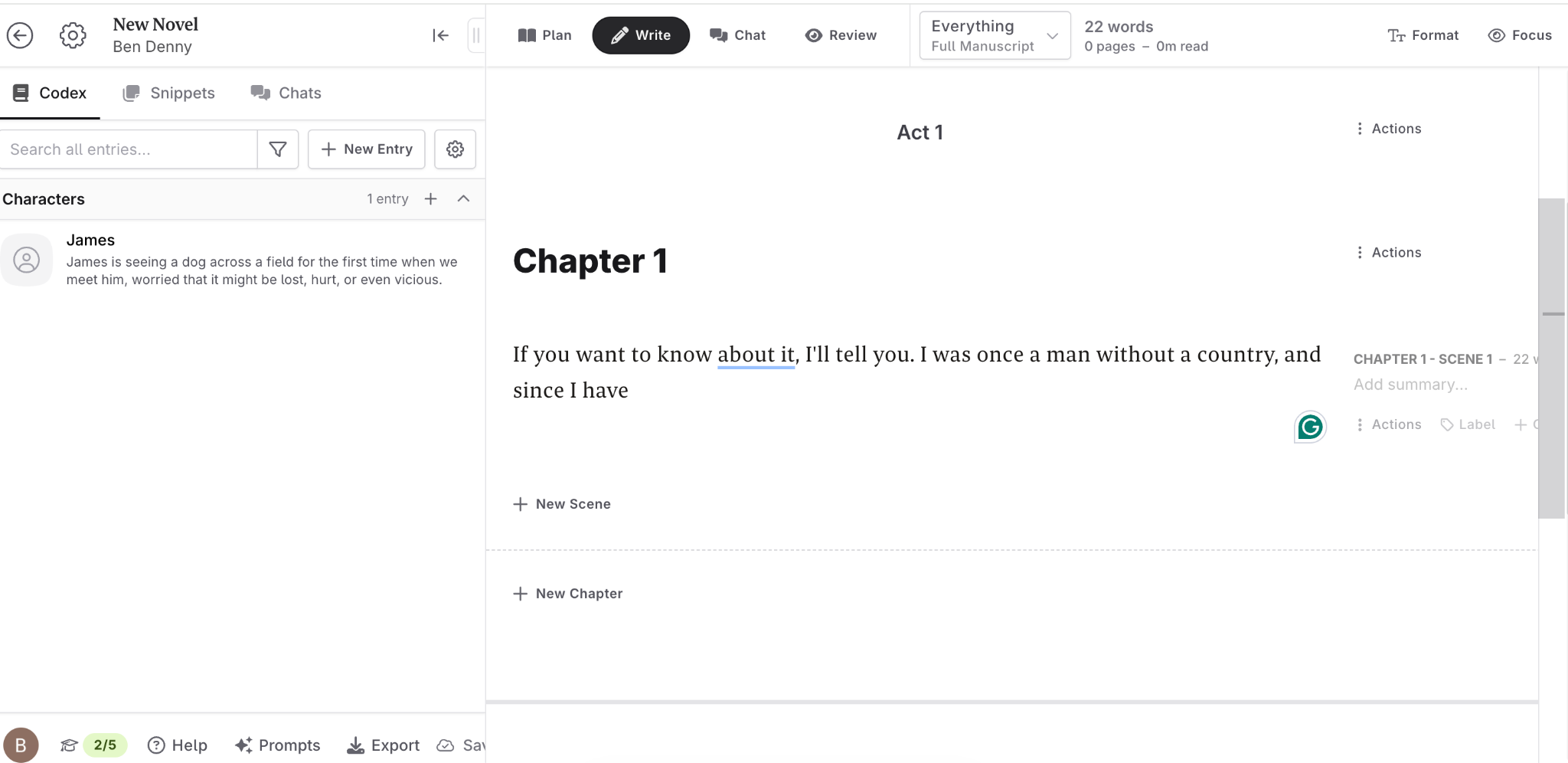
For instance, here we might want to get to normal word-processor tools to edit our text, or to chat with the AI assistant to generate new parts of the novel. Each takes some doing - either changing a tab (and obscuring the manuscript) or searching around for the right button to press.
It’s not that NovelCrafter is insanely bad; it’s actually usable. But our flow was broken again and again as we reached for its capabilities over the course of a chapter, as opposed to the always-in-the-mix feel Type.ai gave us.
Editing and rewriting a novel
But what if we wanted to edit? That can happen in one of several ways. For instance, we might ask the assistant to change our setting from something more conventional to a more sci-fi world:
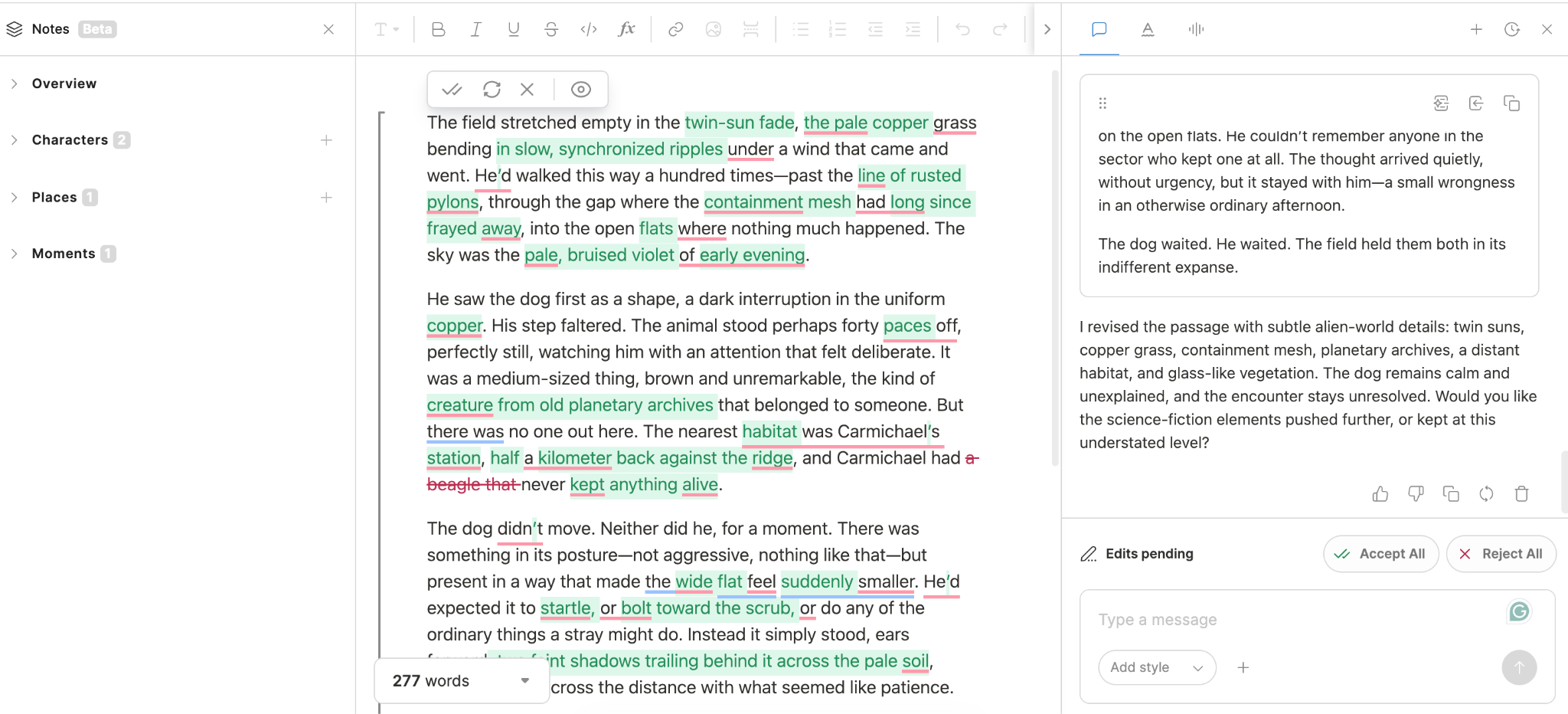
Each of those proposed revisions can be accepted or rejected one at a time or as a batch. The same goes for lengthening, shortening, or refining sections:
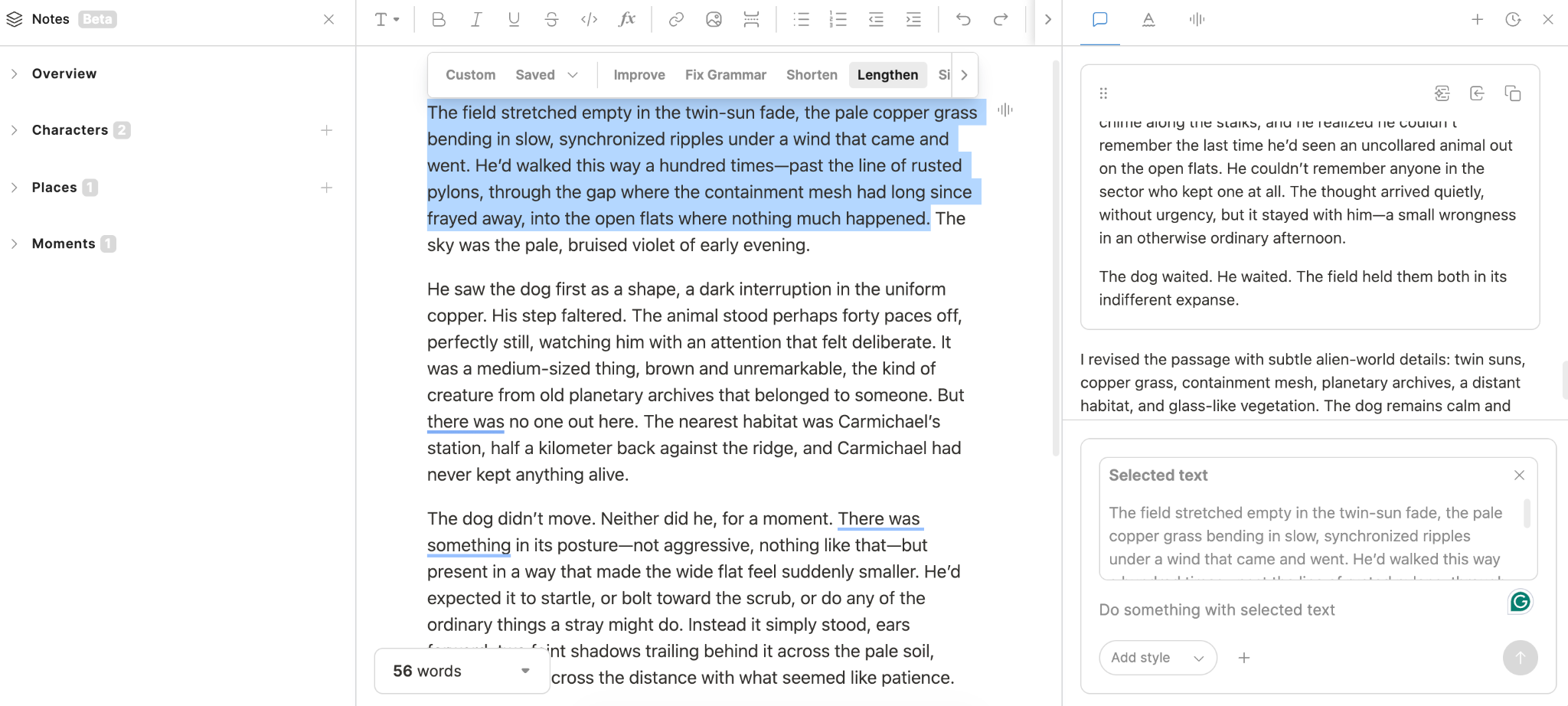
NovelCrafter, to be clear, has some of the same functionality. But the focus feels and operates in a much different, busier way:
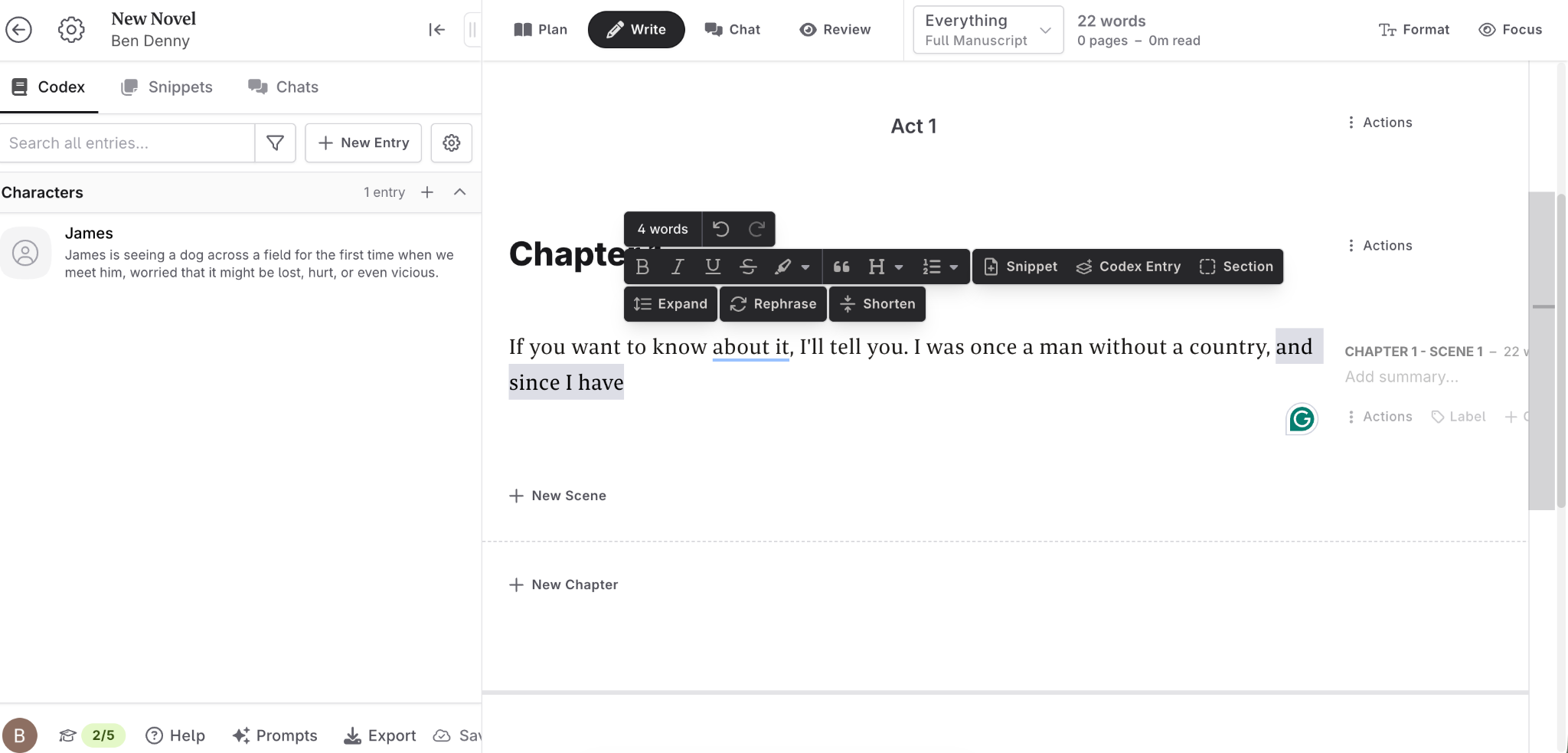
Overall, Type.ai wins as much for feel and efficiency here as it does for raw capability. It’s easy to make changes yourself, or to have the AI propose changes you can then approve or deny in-context within your story. That intuitive, clean feel gives it a serious edge.
Which tool handles long manuscripts better?
Long-form support can mean different things to different people. For instance, some might take that support to mean a web of notes that helps the writer remember details about their world again and again during the writing process, especially as the world becomes more complex.
For us, long-form support often means the ability to keep all of our text in one place, so we aren’t going from document to document to see different chapters and sections. In that sense, supporting a long project means being able to support very large wordcounts without getting overloaded or hitting a hard limit.
In the first sense where author-knowledge support is key, both tools do a very good job and which one you prefer will largely be a feature of how you like to work. Type.ai’s lightweight, mostly-automated note-taking will support you without you having to lift a finger, while NovelCrafter’s more in-depth tool takes some learning but allows for a level of manual-entry driven granularity some authors need.
As for document size, Type.ai publishes a huge 150k word supported document size, well over the 80-100k words of a typical published novel. NovelCrafter does not seem to explicitly publish document-size limits, but we’ve found it handles large documents fairly well.
On net, we prefer Type.ai’s works-in-the-background approach to notes better, but your mileage might very well vary based on your project’s needs.
AI models, API keys and setup
It’s not possible to answer the question of which model works better definitively. For one, the answers are necessarily subjective; as a writer, you might prefer how one model handles your prose for a number of different reasons that go beyond raw power.
In our opinion, the better question to ask is about model access. If you find Claude isn’t doing the job quite the way you want it, it’s really useful to be able to switch to ChatGPT or another model to get a different spin on the work.
Type.ai covers most needs by giving access to high-end models from OpenAI, Anthropic, and Gemini. For most people, this is enough to cover every need while ensuring that the quality of output and edits stays high.
NovelCrafter takes a different approach by allowing for almost any model whatsoever, so long as a user has the know-how to bring their own API key and configure it to their account. The biggest advantage of this is that it allows for lower-cost, less-powerful model tokens to be used. The largest source of friction related to this is set-up time and juggling multiple bills, since buying tokens and the subscription to a tool are not a single convenient action.
We like Type.ai better overall, since the use of lesser models is of limited use to most writers, Type.ai’s token allocation at various subscription tiers is more than generous, and their free tier means that some writers will end up paying nothing to get a level of use that NovelCrafter requires two or more subscriptions to meet. The tradeoff between control and convenience is real and significant, but for most authors Type.ai is, on-balance, the option that makes sense.
Type.ai vs NovelCrafter pricing
Differences of price between Type.ai and NovelCrafter are not simple one-to-one comparisons. Type.ai’s subscriptions are an all-in-one product; NovelCrafter’s represent different tiers of tool capability driven by any of dozens of choices of outside-the-app token purchases from a similar number of AI models.
This means that, for instance, a writer using NovelCrafter in conjunction with a very low-cost, low-powered model might be able to do an enormous amount of work for very little money, with a corresponding loss of quality. Or a writer using Type.ai who gets everything done within a defined tier’s limits might save overall, as they are only spending one fee to get everything they need to write.
NovelCrafter’s Hobbyist tier roughly corresponds in price to Type.ai’s annual-billed Basic plan, before tokens. The difficulty in comparing the two is not just that NovelCrafter’s $8 tier doesn’t come with tokens, however. It’s that Type.ai’s tiers only differ by token counts, not capability - the Basic plan does everything that the Max plan does, only limited by the amount of tokens you use. NovelCrafter’s advanced features (such as chat) are gated behind higher tiers, increasing the cost of the product to get the full utility it offers.
Overall, the total ticket price of either option varies quite a bit depending on different factors. But on net, most writers will prefer a predictable cost from a single point of purchase, and as a result should choose Type.ai.
Where NovelCrafter is better
There are several places where NovelCrafter is easy to explicitly recommend over Type.ai. Type’s simplicity and powerful refinement tools are great, but every AI tool has places it excels, and Novelcrafter is no exception.
The most noticeable place Novelcrafter wins over Type.ai is in the pure depth and power of its Codex. It provides tools for tracking characters, locations, and lore that go far beyond Type’s current build in terms of sheer attention to even miniscule details. It allows for complex planning across not just entire novels but whole series, meaning that users can keep their worldbuilding consistent book to book with no more effort than it took to build the lore in the first place.
While NovelCrafter’s bring-your-own-API key features aren’t for everyone, they are also incredibly powerful in the right hands. The ability to utilize advanced prompting control over a variety of models, each chosen for a specific mixture of performance and price control, is not at all to be understated. It’s an incredible feature, and only NovelCrafter has it.
For the users that need that combination of world-building power and model flexibility, NovelCrafter is an unqualified great choice.
Where Type.ai is better
We’ve covered a lot of the reasons Type.ai is generally better for most authors than NovelCrafter, even though NovelCrafter has a definite place as an option for some. Bringing it all together in one place, we find these are the best reasons to choose Type over other options, NovelCrafter included:
- Type.ai is an all-in-one service that provides a generous amount of use tokens at every subscription tier.
- After subscription (or even on the free tier), the writing process starts in seconds, putting you directly into your best flow.
- Type’s workflow is built entirely around the document you are working on. Writing, AI generation, human-powered editing and AI-powered revision all happen within the same view on the interface.
- The interface itself is simple, calm, and always focused on the work; it requires a near-zero amount of learning curve to know where every tool you need is
- In-line editing and revision are super-simple to use and powered by the latest ChatGPT, Claude and Gemini models
- Users can enjoy a more predictable product experience with no knowledge of API keys, obscure models, or specialized configuration.
Overall, it’s the perfect environment to work without having to move between interfaces, futz with settings, or climb a learning curve while still getting top-level results.
Which NovelCrafter alternative fits your writing process?
We put together a decision table for you detailing what each program is best at, as well as the biggest limitations of every platform we’ve discussed. We hope it helps you make the right choice for your writing needs, whether with a single all-in-one solution or a combination of products.
Final verdict: What is the best NovelCrafter alternative?
AI writing tools are a complex, ever-changing topic. Even so, we think we can give you a direct conclusion here: For most AI writing needs, Type.ai is the best environment you could ask to write and revise with. If you want to do serious work quickly and edit in-line with that work in one slick, uninterrupted flow, you want Type.ai.
If worldbuilding and note-taking are all important, NovelCrafter and Sudowrite might also make sense, in the same way that Scrivener, Plottr and Obsidian all make for good choices for writers looking for non-AI organization tools. And, of course, if you want absolute choice over which AI models you use in an AI integrated tool, NovelCrafter reigns supreme.
Frequently asked questions
What is the best NovelCrafter alternative?
Type.ai is best fit for writers who want a manuscript-first workflow. NovelCrafter’s Codex makes it a good choice for writers who want stronger worldbuilding tools and don’t mind longer setup and learning times.
Is Type.ai better than NovelCrafter?
In most ways, yes. NovelCrafter is stronger if you need more granular worldbuilding or greater API key control over model usage.
What is the main difference between Type.ai and NovelCrafter?
Type.ai is a faster, cleaner, and better realized environment to write and edit in. NovelCrafter has stronger world-building tools and lets you use almost any AI model with an API key.
Is Type.ai easier to use than NovelCrafter?
Setup is definitely faster, and the learning curve of Type.ai is much quicker. NovelCrafter can do a few things Type.ai can’t, mostly in terms of AI model choice and in-depth worldbuilding.
Does Type.ai require an API key?
No. Type.ai comes with top-tier OpenAI, Anthropic, and Gemini models integrated into the product and usable at any subscription tier.
Why does NovelCrafter require an AI provider?
NovelCrafter is a writing platform product that allows for integration of almost any AI model. As such, it doesn’t include every AI model in its subscription, and instead allows users to “hook up” whatever model they like via API key. This means paying for each model’s tokens separately.
How much does NovelCrafter cost with AI usage?
Their AI-enabled platform is available for $8 a month, but doesn’t include tokens for your chosen AI models. Costs for tokens vary wildly between various AI models, so the overall price tag for NovelCrafter is impossible to predict without knowing which models you use, and for what.
Is Type.ai cheaper than NovelCrafter?
Sometimes, yes. Type.ai’s token allocations are very generous at any tier, so writers often save money compared to NovelCrafter. With that said, NovelCrafter allows for very low-cost AI model usage, and is sometimes the cheaper choice
Which tool is better for writing a novel?
Type.ai is better for staying focused, informed, and effective over documents up to 150,000 words. Its inline editing and refinement tools are easier to use. NovelCrafter is better if your writing process requires very in-depth worldbuilding, or if you plan on using an uncommon AI model to create your prose.
Which tool is better for editing a manuscript?
Type.ai’s inline manuscript editing tools are easier to use and more accessible than NovelCrafter’s, and writing in their environment feels easier, faster, and more productive.
Which tool is better for worldbuilding?
NovelCrafter is. Its worldbuilding tools are top-notch and very powerful. Type.ai’s tools are very easy to use and good in their own right, but simply can’t do as much for very planning-heavy processes as NovelCrafter’s can.
Is NovelCrafter better for book series?
For planners, it can be. Their series-level lore and worldbuilding tools are very good for keeping things consistent across multi-book projects.
Is Sudowrite a good NovelCrafter alternative?
Yes, for some. Sudowrite’s AI-generation heavy workflow encourages “automatic” writing powered by your own ideas, and its story bible tools are very powerful and usable.
Is Scrivener an AI writing tool?
No. Scrivener is a non-AI organizing tool.
Can Type.ai handle a full novel?
Type.ai can handle 150k word documents, well over the average length of a modern novel.
Can Type.ai export to Word, PDF, HTML and Markdown?
Yes. All of those export formats are supported.
Is there a free NovelCrafter alternative?
Type.ai has a free plan with limited credits that can absolutely fit some novelists’ work pace. Try it out!
Can Type.ai and NovelCrafter preserve an author’s voice?
No AI tool can fully substitute for an author’s voice, but both tools allow for detailed instructions and style notes to guide writing to be as close as possible. How close a tool gets depends a lot on how much effort a human puts into guiding the process, as well as how much they edit AI prose after generation.
Can I use Type.ai or NovelCrafter for nonfiction and business writing, or only fiction?
Both, but they lean differently. NovelCrafter is fiction writing software first — the Codex, scene planning and plot-point tools assume a story. Type.ai is general-purpose AI writing software that handles long-form fiction, nonfiction and business writing in the same document-first workflow, with Notes doing lighter duty than a full codex. Fiction authors get more from NovelCrafter's structure; writers who move between genres get more from Type.ai.
Is either tool better than Google Docs plus ChatGPT for a discovery writer starting from a blank page?
For a discovery writer, the main gain is not switching windows. In Google Docs plus a chat tab you copy text back and forth; in Type.ai the AI chat, inline edits and the manuscript sit in one view, so the blank page turns into a draft without leaving the document. NovelCrafter suits planners more — its setup rewards outlining before writing. Neither replaces the writer's own storytelling process, and both still leave final formatting for export.