
Authors Who Should Choose Type.ai
- Writers who want to get started quickly: Type.ai combines the editor and supported AI models in one subscription. You can begin drafting without setting up a separate AI provider account or any complex set up.
- Experienced authors who edit as they go: Type.ai’s editing tools can correct grammar, smooth out odd phrasing, and look for improvements on the sentence and paragraph level, all without leaving the text or interrupting your workflow.
- Writers working across fiction and nonfiction: Type.ai’s document-first workflow is not limited to fiction-planning structures and works as well for nonfiction writers.
Writers Who Should Choose Novelcrafter
- Technically-minded writers who want API control: Novelcrafter allows users to hook its tools up to any AI powerplant they want above and beyond the three top-shelf options Type.ai offers. This allows users to pick specialized or self-hosted local models, or lower-powered but dirt cheap options.
- Budget optimization wonks: If you are technically minded and can compromise significantly on model quality, the ability to use a less powerful model can result in savings over huge amounts of token spend, with a corresponding trade-off against model power.
- Heavy, in-depth worldbuilders who need granular lore notes that capture every element of their created worlds. Codex provides this at a level most other AI-powered tools can’t match.
Cost is also a significant consideration. Type.ai’s paid plans start at $8/month with annual billing and include AI credits; Novelcrafter’s Hobbyist tier (the first tier with AI tools) costs about $6.67/month with annual billing, and AI usage is billed separately through your model provider.
The Real Difference: Who It Is Built for & Who Supplies the AI
Type.ai
Type.ai focuses on making a product for serious writers, a tool that’s as powerful as possible while not getting in the way of your creative flow. Since powerful, top-level models from Anthropic, OpenAI, and Google are included in the subscription price, it’s complete and ready to go out of the box with near-zero levels of setup and almost no learning curve. It just works, and it keeps working throughout even the longest of projects.
Our experience using their tool was that we could type a section in the old-fashioned way, and then zig-zag to grammar checks, sentence-level refinements, and suggestions on what to do next without ever taking our focus on the words themselves.
The simplicity of the interface is what makes this work. It’s obvious where all the editing tools live, and using them is as simple as highlighting the text you want changed and hitting a button. The AI chat functions “just work” and can make complex changes based on simple prompts. There’s no point where your attention is taken away from your working document, forcing you to “find your way back.” It’s simply always there, surrounded by all the tools you need to edit on the fly, directly in the text.
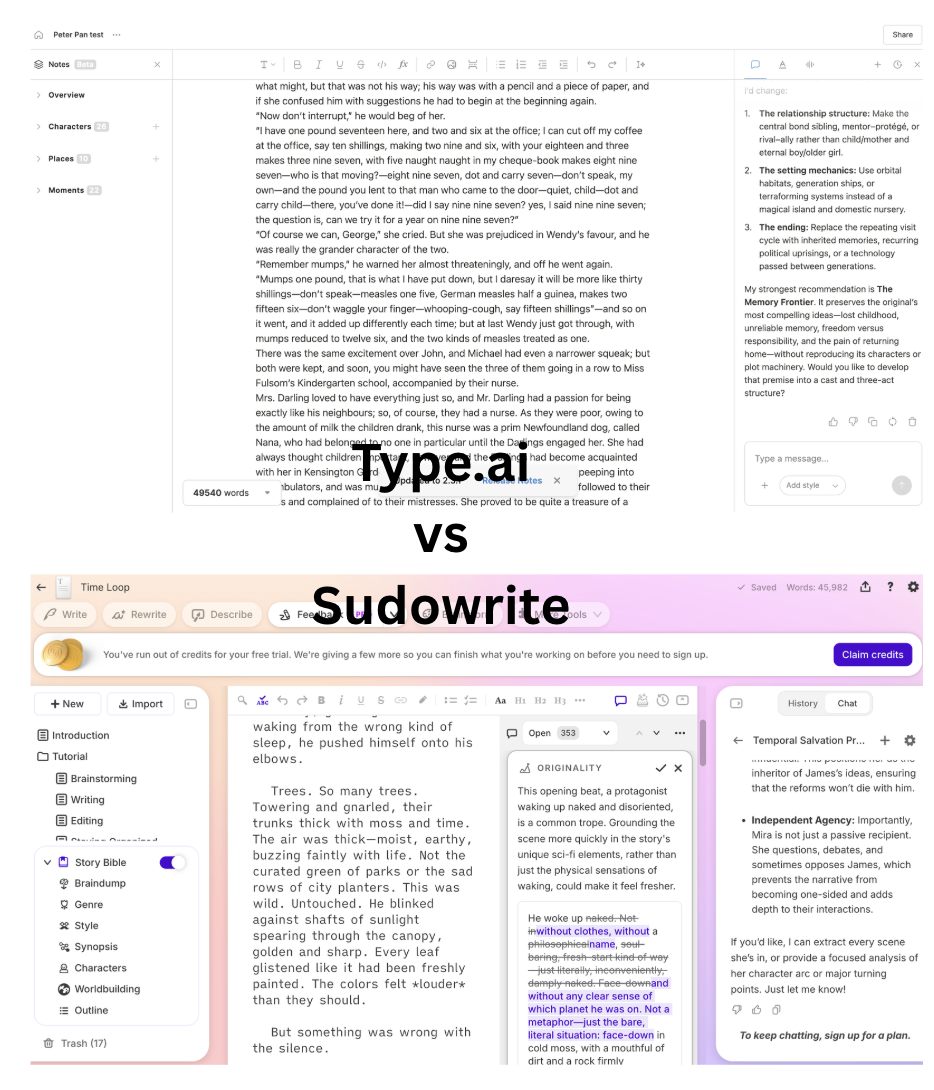
Broadly speaking, there’s no level or type of writer who this doesn’t work for. There are tools on the market that surpass Type.ai’s capabilities in one or two narrow places (Sudowrite’s story bible functionality, for instance), but its general mix of powerful AI tools covers almost every need without ever feeling “busy” or confusing. For most authors working in any fiction or nonfiction genre, it’s a near-perfect choice.
Novelcrafter
Our impression of Novelcrafter is that it’s a strong tool that does what it’s intended to do. It meets a narrow but real need for certain techy writers that no other tool on the market can: It’s a functional tool that can use almost any AI model as its underlying powerplant, including obscure or locally-hosted options no other AI writing tool supports.
Novelcrafter’s biggest pitch is this “bring your own key” functionality, meaning that writers can use their interface with any AI account they want serving as the powerplant behind the AI tools. This means that Novelcrafter users have a lot of choice, plus the possibility of saving a bit of money by using a less expensive or locally hosted model for certain tasks.
It also means a fair amount of setup and juggling separate bills both for the tool itself and the LLM powerplants that make it run. Every AI model a writer wants to use needs its own separate account and its own separate billing. On one side, users pay for Novelcrafter’s tools; on the other side, they pay another bill for tokens powering the AI models they want to use. A user running six different models on Novelcrafter is juggling seven different bills to Type.ai’s one.
For some writers, this is wonderful and exactly what they need. For others, it means work to do before ever getting around to writing. The same logic applies to Novelcrafter’s “Codex” tools. If you need a way to keep characters, locations, and factions straight at an in-depth, no-stone-left-unturned level of complexity, Novelcrafter is perfect. The learning curve is real, though, and might feel excessive to writers who just want top-performing AI models that “just work” without any setup.
Head-to-Head Summary
Type.ai optimizes for reducing friction at all times. It comes with high-powered Anthropic, OpenAI, and Google models pre-bundled in the subscription price, and requires almost no setup to use. Type.ai is the best option for authors who want powerful AI efficiency tools without managing multiple accounts or making frequent choices between AI models.
Novelcrafter is a good tool and Codex’s depth of worldbuilding is unmatched, but it optimizes for control instead of low-friction workflows. It allows you to pick any AI model you want, which some techy writers will appreciate. This trades off with ease of setup and makes it necessary to juggle multiple bills to get the AI functionality you want.
Type.ai vs Novelcrafter - Detailed Comparison
We put together a side-by-side comparison of these two products so you could see, at a glance, which works best for which situation.
Pricing and feature details verified as of Sep 2026. See Type.ai pricing, Novelcrafter pricing, and our full Novelcrafter alternatives comparison.
Evidence: The Hands-On Tests
Test 1 — Setup to First Paragraph
Our first test has to do with speed. How long does it take to start a new account with either Type.ai or Novelcrafter, then move through any obstacles in the way of generating all the way to the creation of a new paragraph of text?
For most writers, this is a one-time cost; once you have a particular service set up the way you like it, it tends to stay set up; you’d only change it if you wanted to expand what it could do. This means that, whoever the winner of this test, the implications are somewhat limited; this is a pain you only feel once.
All tests in this section were completed as of 9/21/2026; modern apps change often, and these flows might be different at a later date.
Type.ai Setup Speed Test
Type.ai’s test was fairly straightforward. The site uses normal sign-in-with-your-email functionality, so connecting it to our Gmail account took a moment at most. After that, Type.ai presents a writer with a short sequence of questions to figure out how to do its best work:
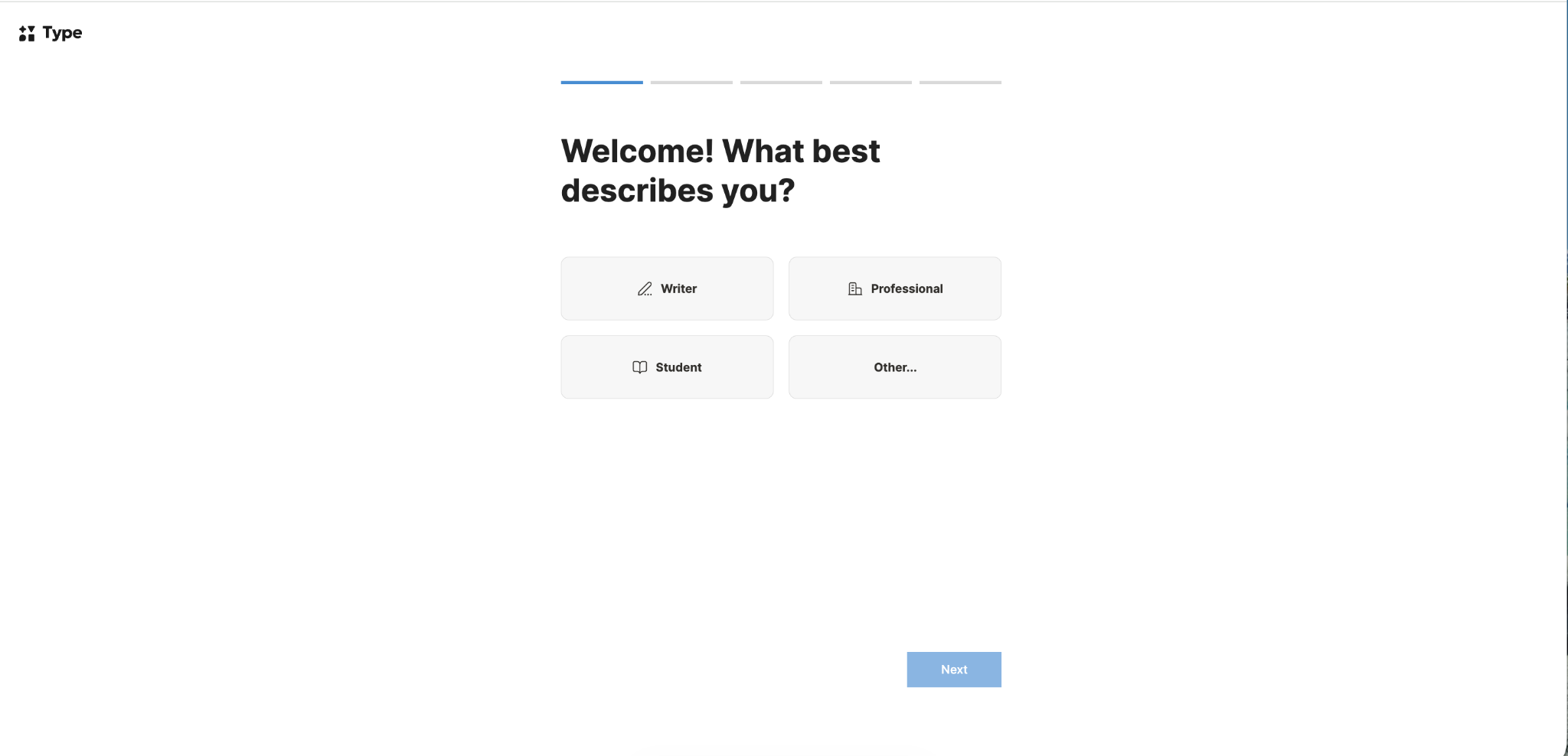
After that, you are taken directly to a new draft page, ready to generate text. The big question at this point is whether or not all the promised functionality actually works, or whether or not more steps are required to get started.
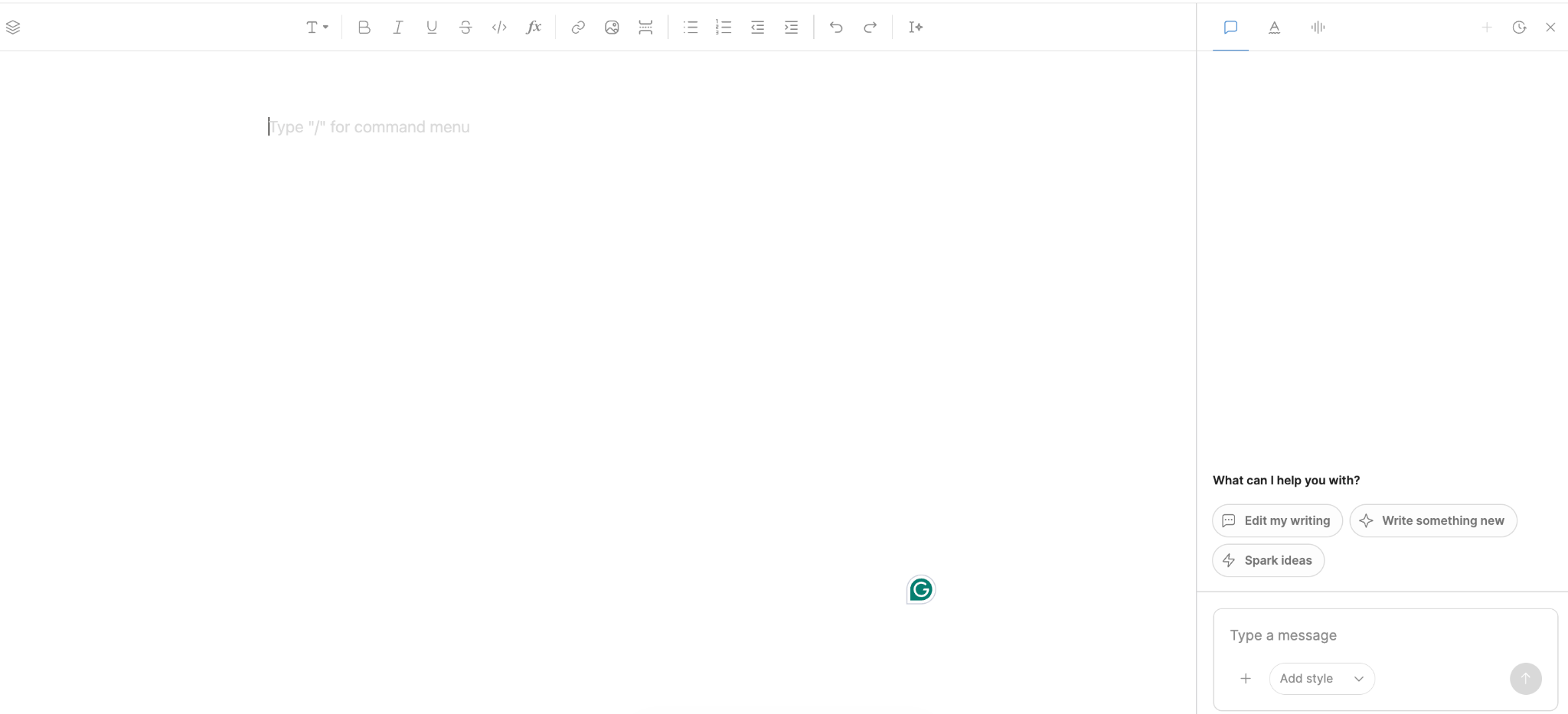
There are not, as it turns out. At this point, you are off to the races, writing and editing with a top-level model from Anthropic, OpenAI, or Google.
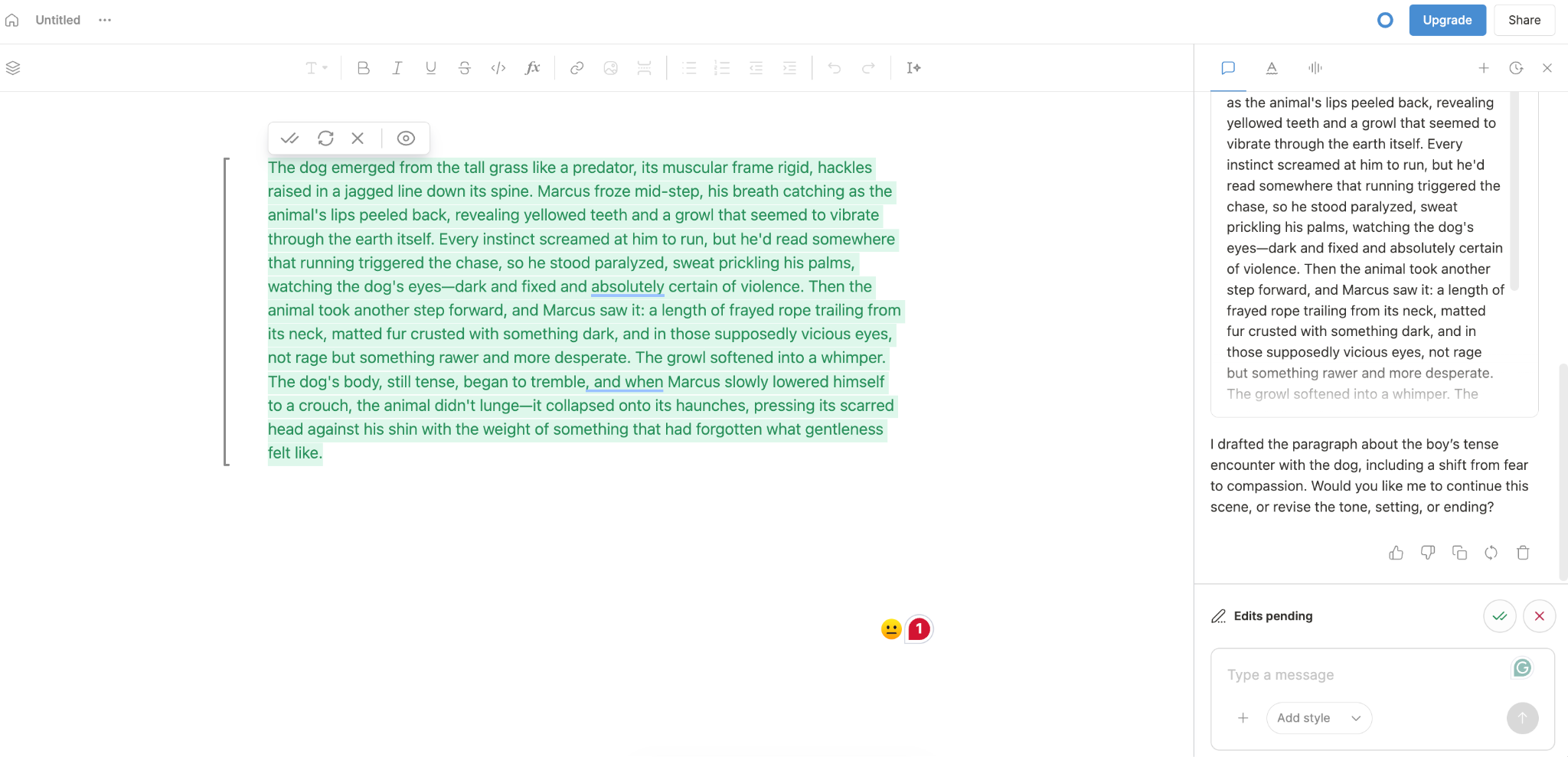
All this took less than two minutes, by our stopwatch; it would have been closer to a minute, but we did confirm that we could switch models at this point without extra friction. Type.ai also now automatically picks the best model for the task in order to optimize the compute cost without you having to make model choices manually.
Novelcrafter Setup Speed Test
Novelcrafter’s process was just as simple as Type.ai’s to a point, but after that turned out to be a much different setup process. The first step is logging in and account creation, which was so nearly the same to Type.ai’s sign-in-with-your-email flow that no significant difference in time occurred.
After that, Novelcrafter also runs you through a set of questions meant to calibrate what kind of writer it’s dealing with. In this flow, we get our first indication that things are a bit different via an up-front disclosure that additional setup and billing are needed to get the tool running:
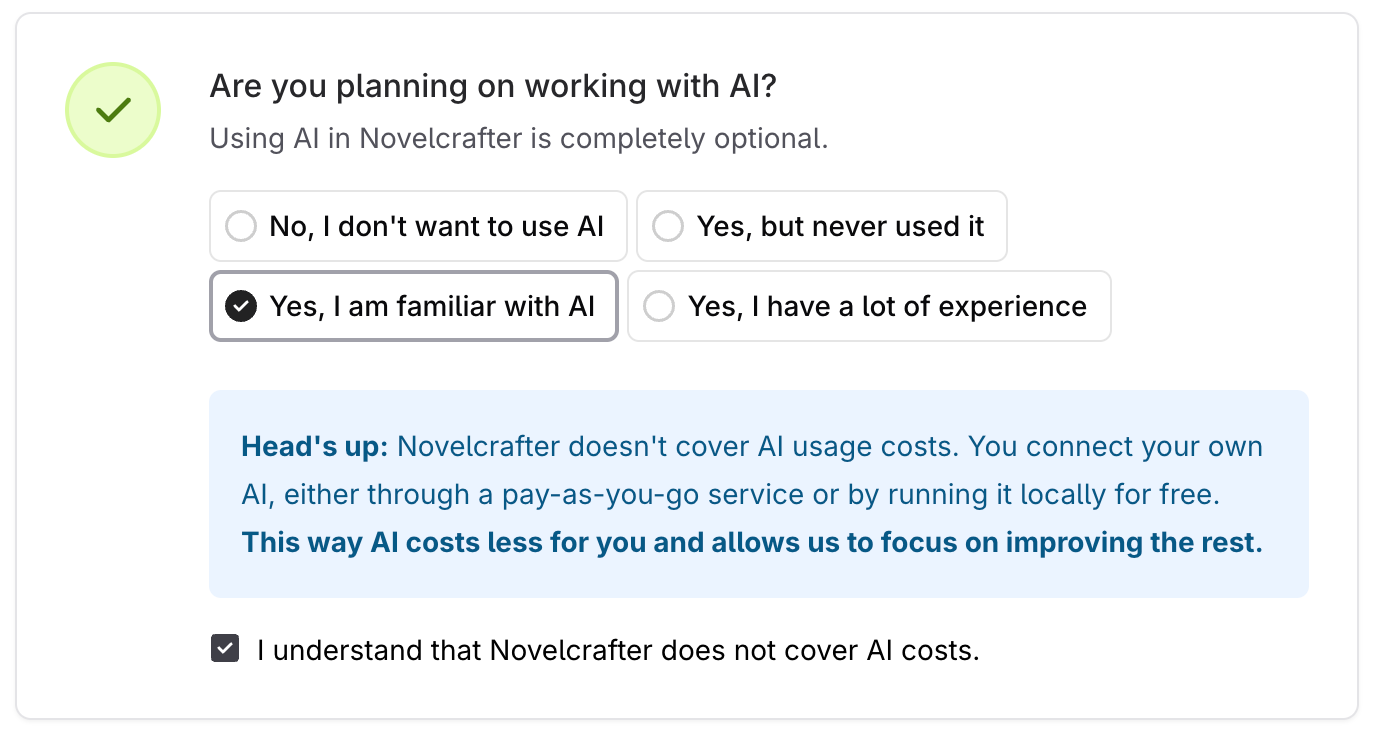
That screen leads into the next two, which get you somewhere that at least superficially looks a lot like Type.ai’s ready-to-go status.
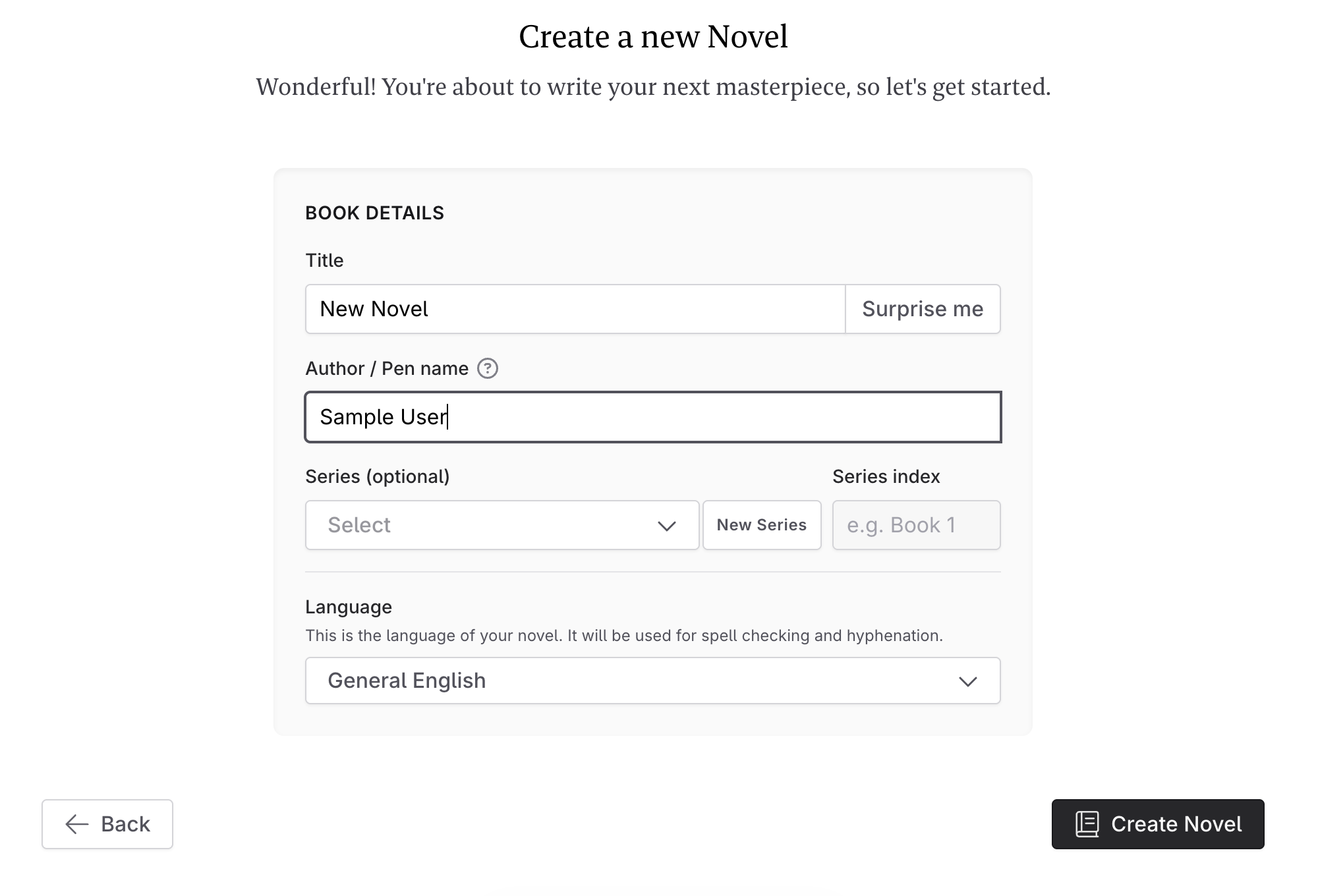
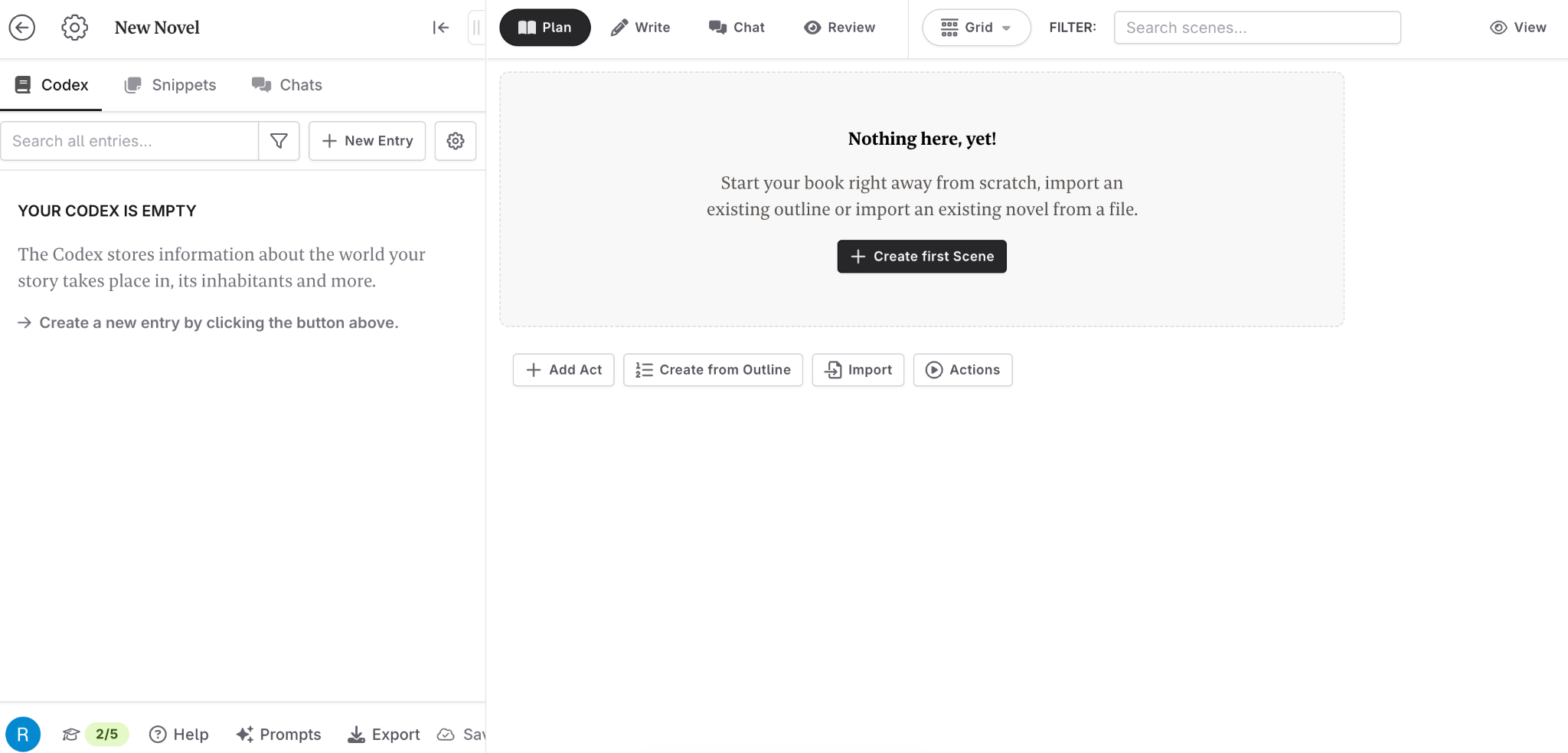
The only problem is that we are not actually connected to AI tools at this point. We could use Novelcrafter’s non-AI tools, like some Codex functionality or word processor utilities. But to actually generate text or edit using AI, we need more.
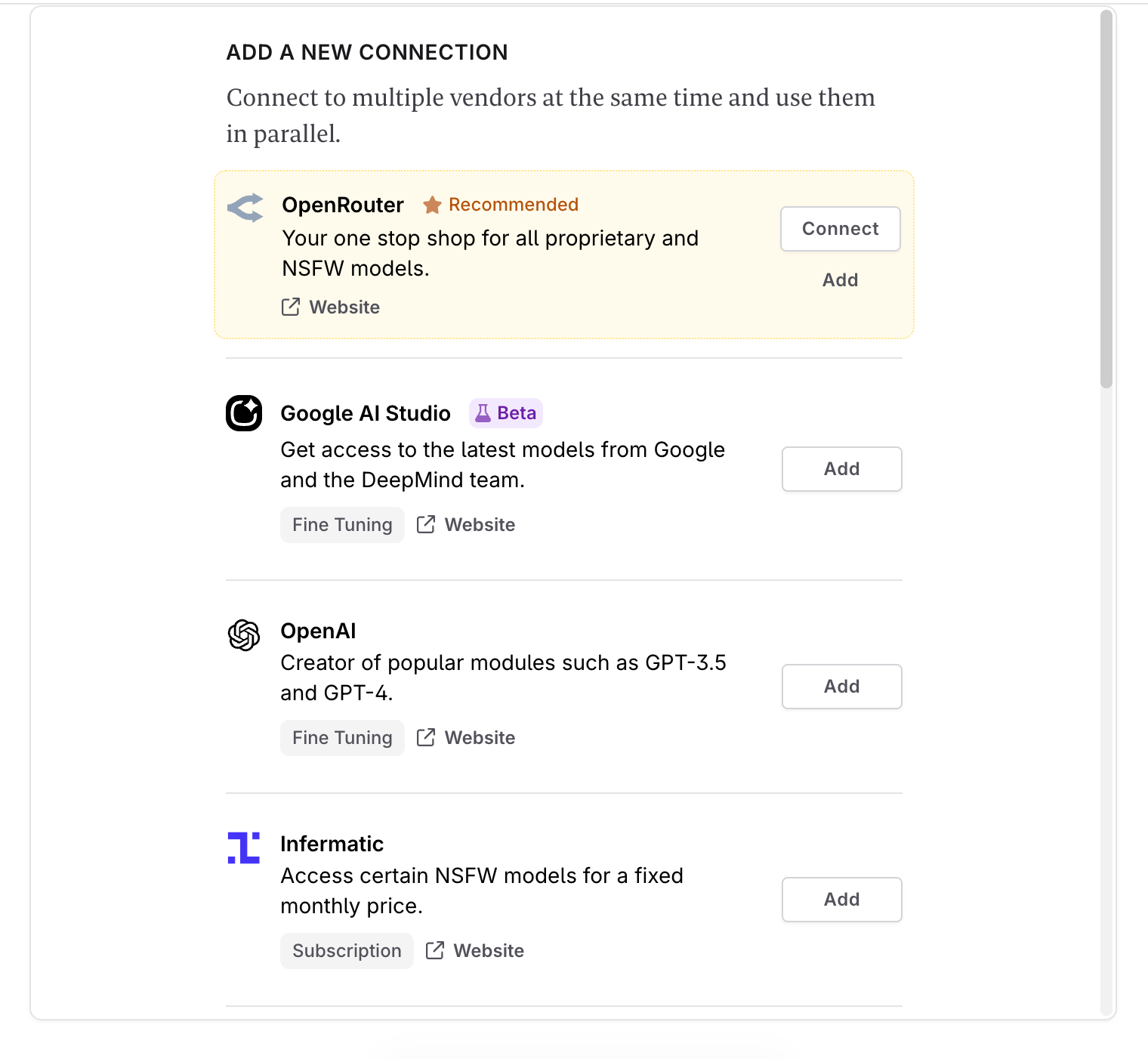

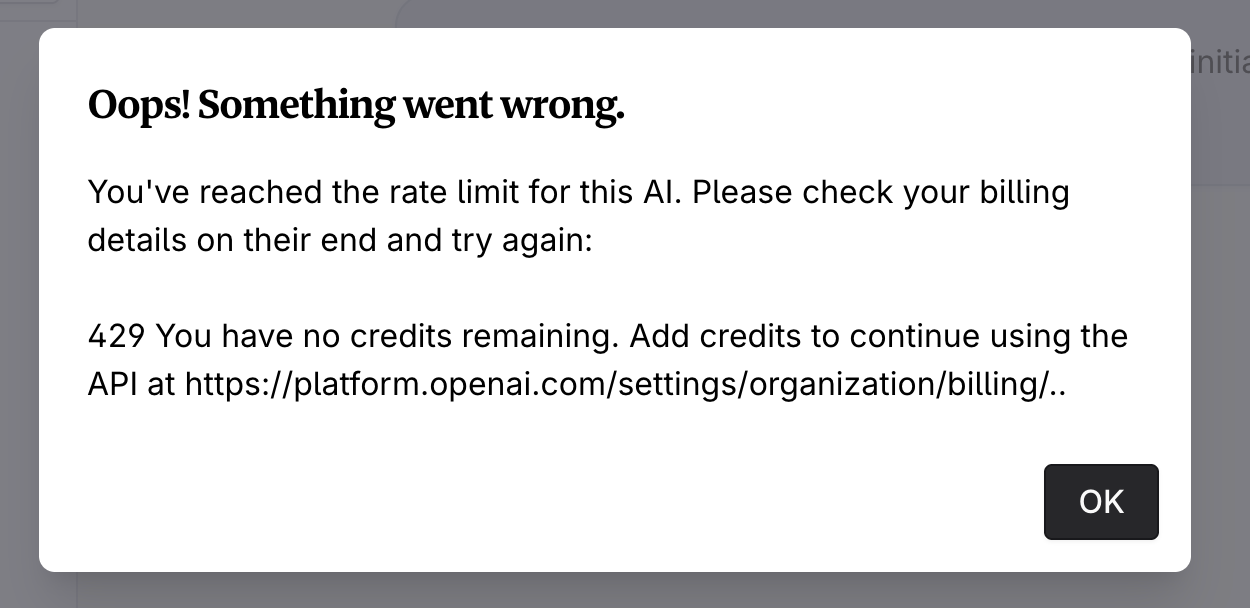
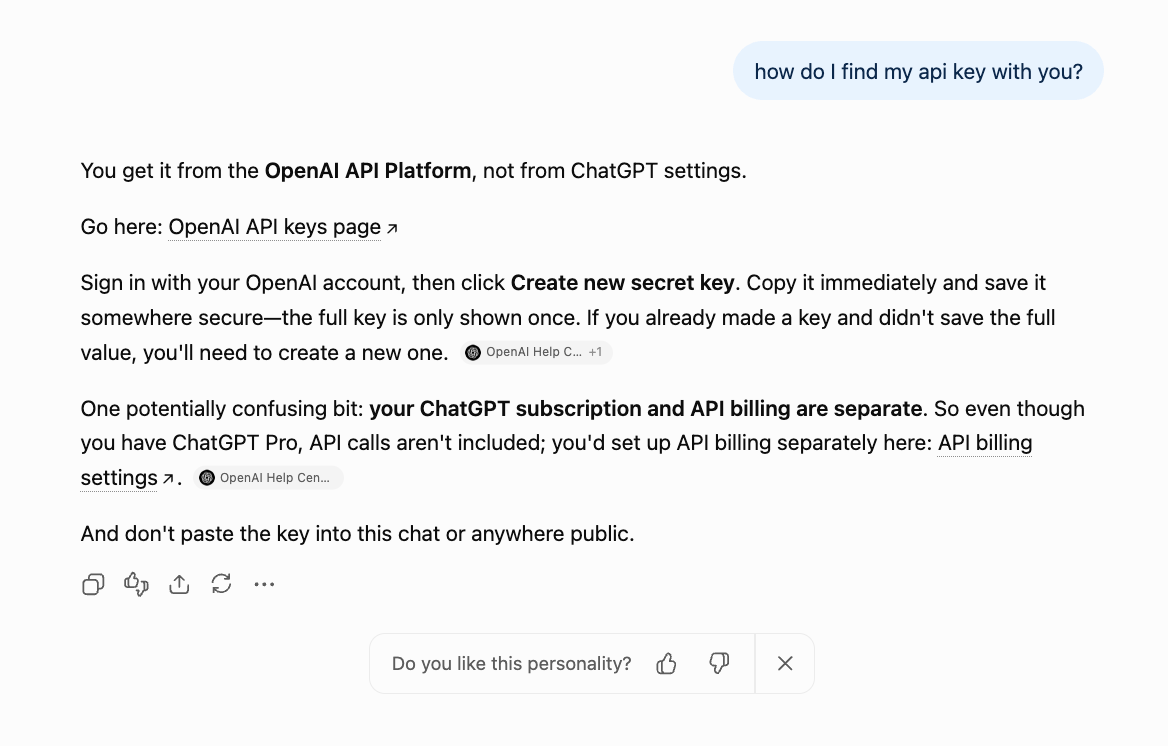
This isn’t a failure of Novelcrafter’s process. It simply bills in a different way; their subscription on one side, and your token provider on the other. But since we don’t already have ChatGPT tokens (they don’t come with the subscription) and we wanted to test with Anthropic models anyway, we move on to doing that.
Novelcrafter links with Anthropic through OpenRouter instead of directly, so we logged on to OpenRouter, created an account, linked payment information, and so on until it was able to provide tokens to Novelcrafter directly. Some of this process we decided not to show, since it represents a security risk if we accidentally took a screenshot, but overall it took about as much time as the whole process up to that point.
But did it work after that?
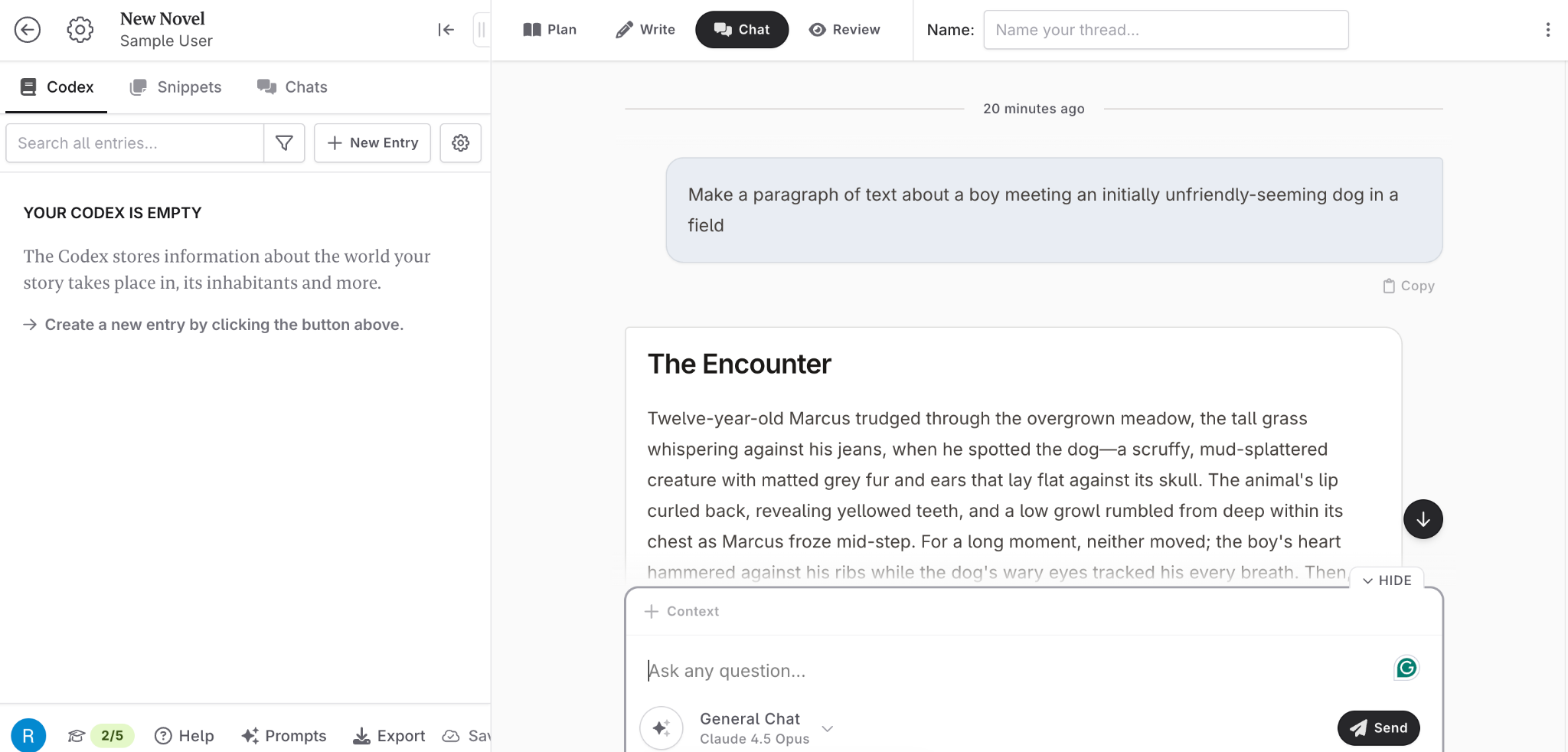
It did! We now have an AI-enabled writing environment, hooked up to as many models as we buy tokens for within OpenRouter. The time outlay was, for better or worse, much longer than Type.ai’s - close to twenty minutes in total (19:43). And that’s with us as fairly expert users, knowing how API keys and utilities like OpenRouter work already.
This is a one-time pain point, so we don’t want to pretend it’s going to be like this every time. But ease of setup is a distinct category even as it’s a limited one, and within it Novelcrafter performs much less quickly than Type.ai. This is a setup process for the patient or the tech-savvy; it’s explicitly not the best and quickest option for people who want to get writing as soon as possible.
The user experience has also been consistent with other as evidenced on this comparison between Novelcrafter and Type.ai.
Long-Form Performance with Long Imports
We uploaded a document of approximately 100,000 words into both tools, one that neither tool had likely seen before. From there, we assessed the tools on three fronts: ease of upload, worldbuilding tool interactions with the new document, and the ability of the tool to understand the uploaded content when interacting with it.
Both tools performed well, but there were significant differences related to their large-document handling skills that Type.ai mostly came out on top of.
Type.ai
Ease of Upload
Type.ai effortlessly uploaded the entire document, keeping the format of the original document without exception. The process took under a minute.
Worldbuilding Tools and Context
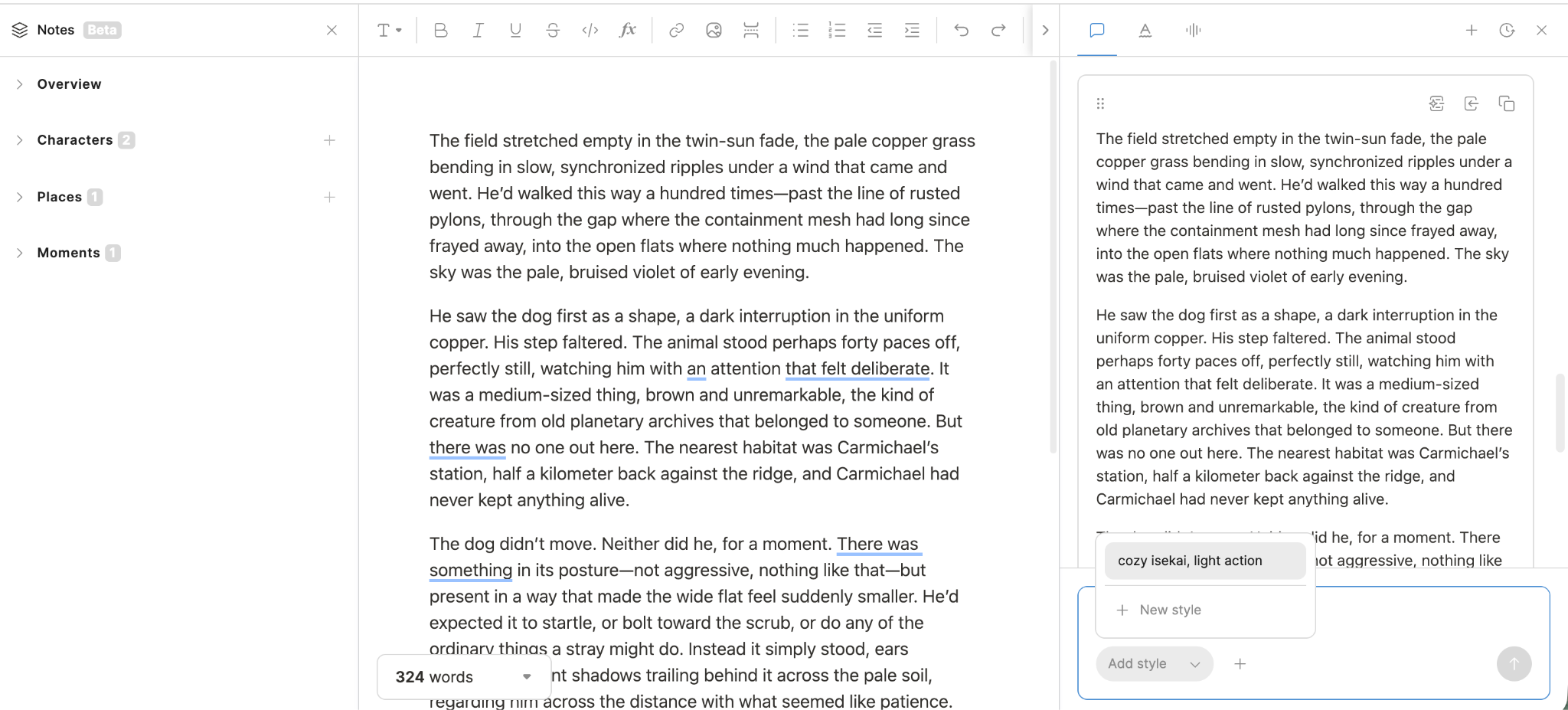
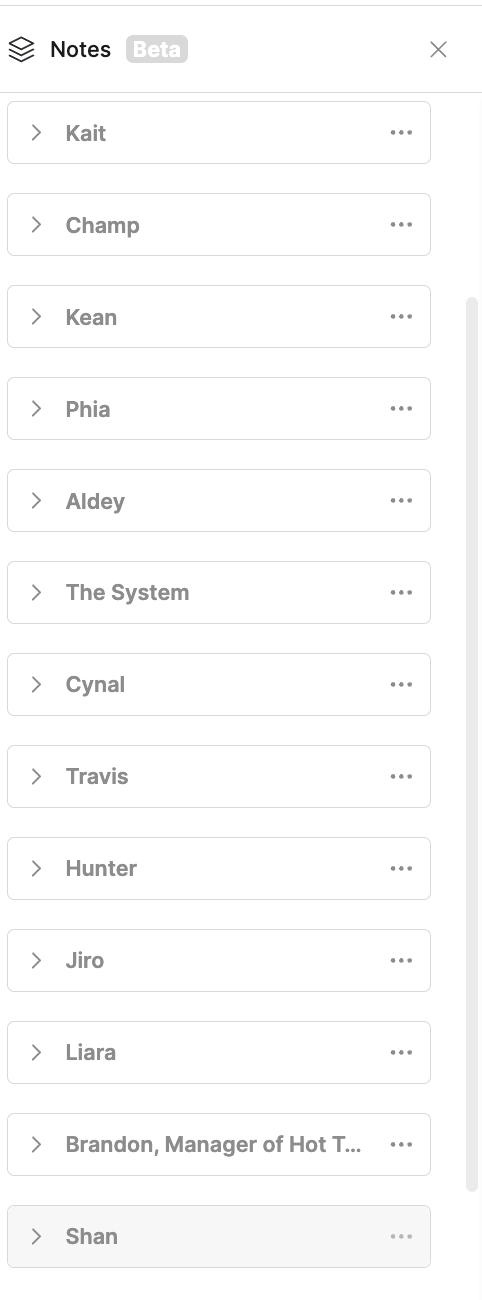
Type.ai automatically updated its Notes worldbuilding tool about a minute after upload, creating a summary of all characters, settings, and scenes.
From there, we asked the Chat assistant a context question from near the beginning of the novel, seeing if it could dig out those details. It did, without trouble and accurately, demonstrating it could “see” the entire context of the novel.
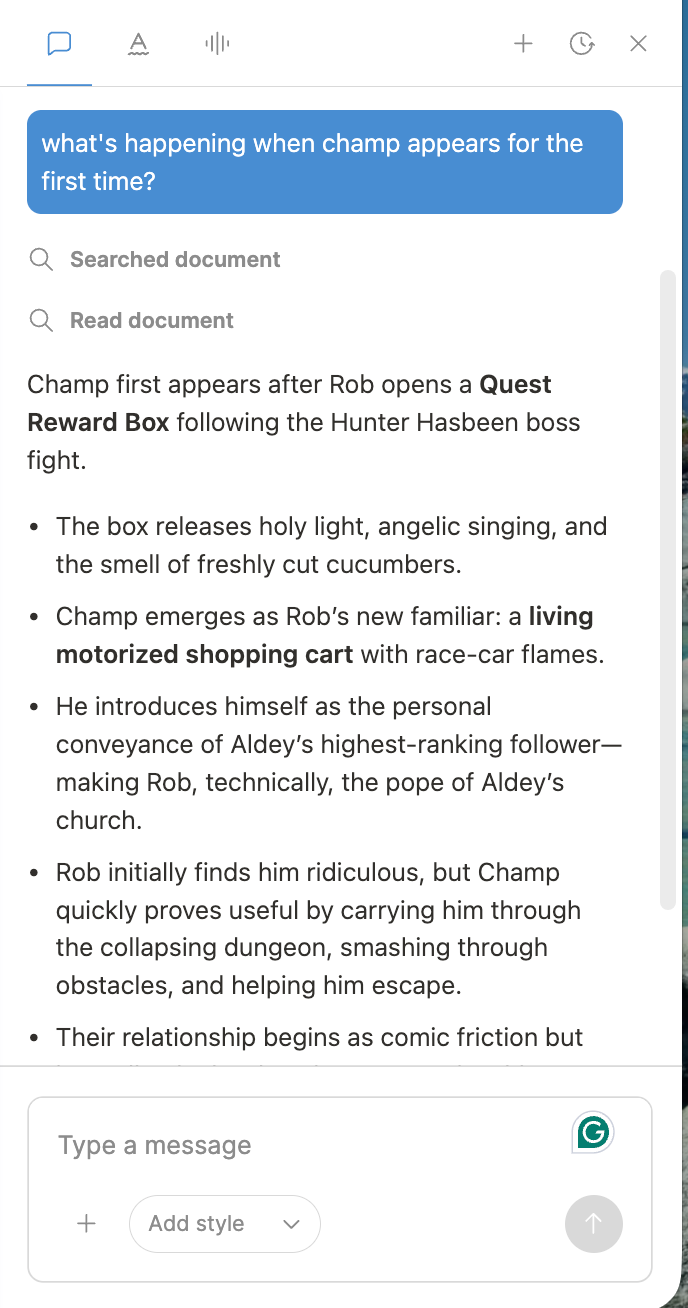
Overall, this is the kind of performance we want to see; the tool “catches up” to the already written material as if you wrote it within Type.ai, and a writer can proceed from that point knowing that all the current context is captured.
Novelcrafter
Ease of Upload
As with Type.ai, Novelcrafter uploaded the file quickly and easily, though it required a second export of the source material (Novelcrafter does not have PDF support for uploads, at least that we could easily find; we created a new docx file to accommodate that limitation).
The formatting was not as effortless; there were settings related to how we wanted the tool to interact with text, and it ended up taking more than a few tries to get the settings to a point where the tool didn’t interpret ordinary linebreaks as section breaks.

Worldbuilding Tools and Context
Novelcrafter’s worldbuilding tools work, but aren’t quite automatic. We could get the chat function to create entries in chat, but it took some manual transfer work to get them from there to the codex. Over the course of a long novel, this is dozens of entries and represents a significant time outlay.
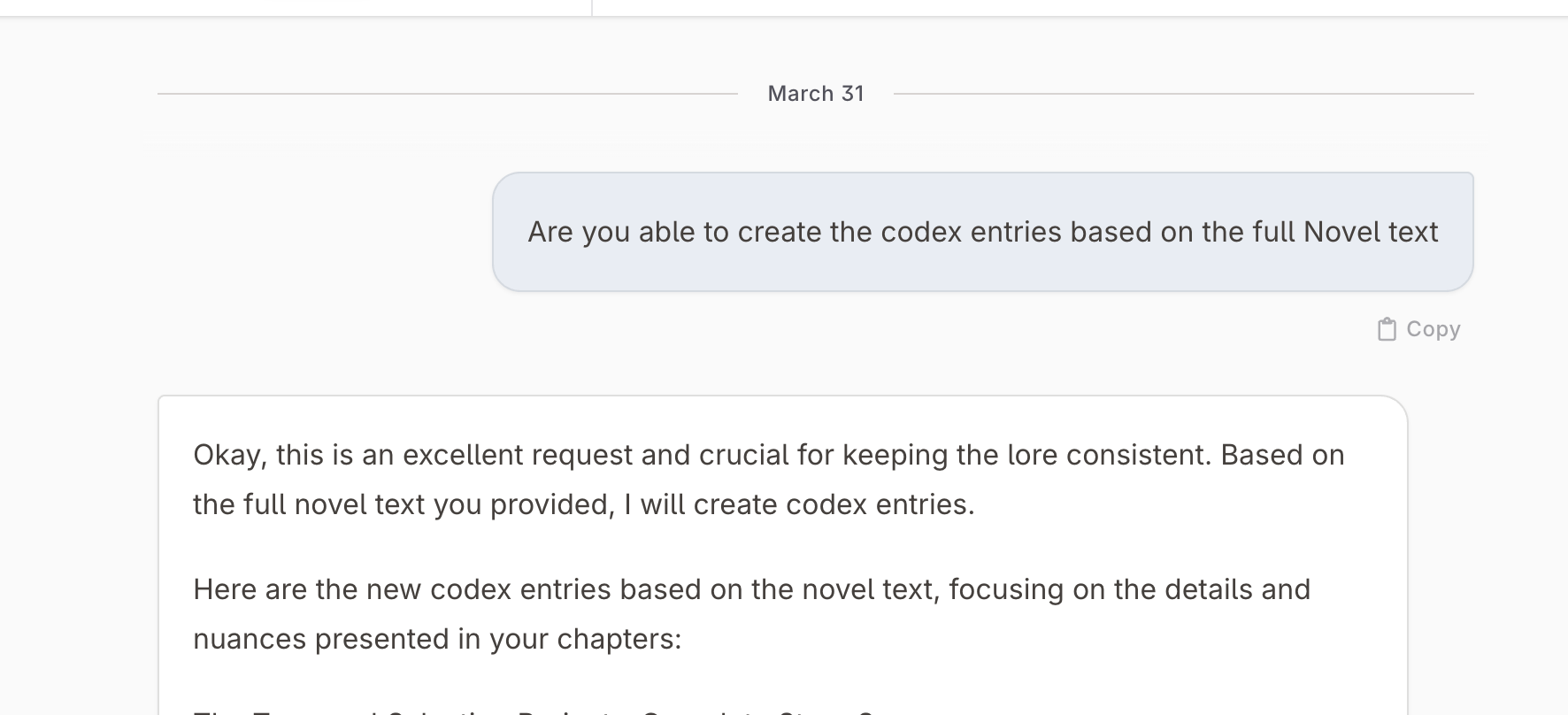
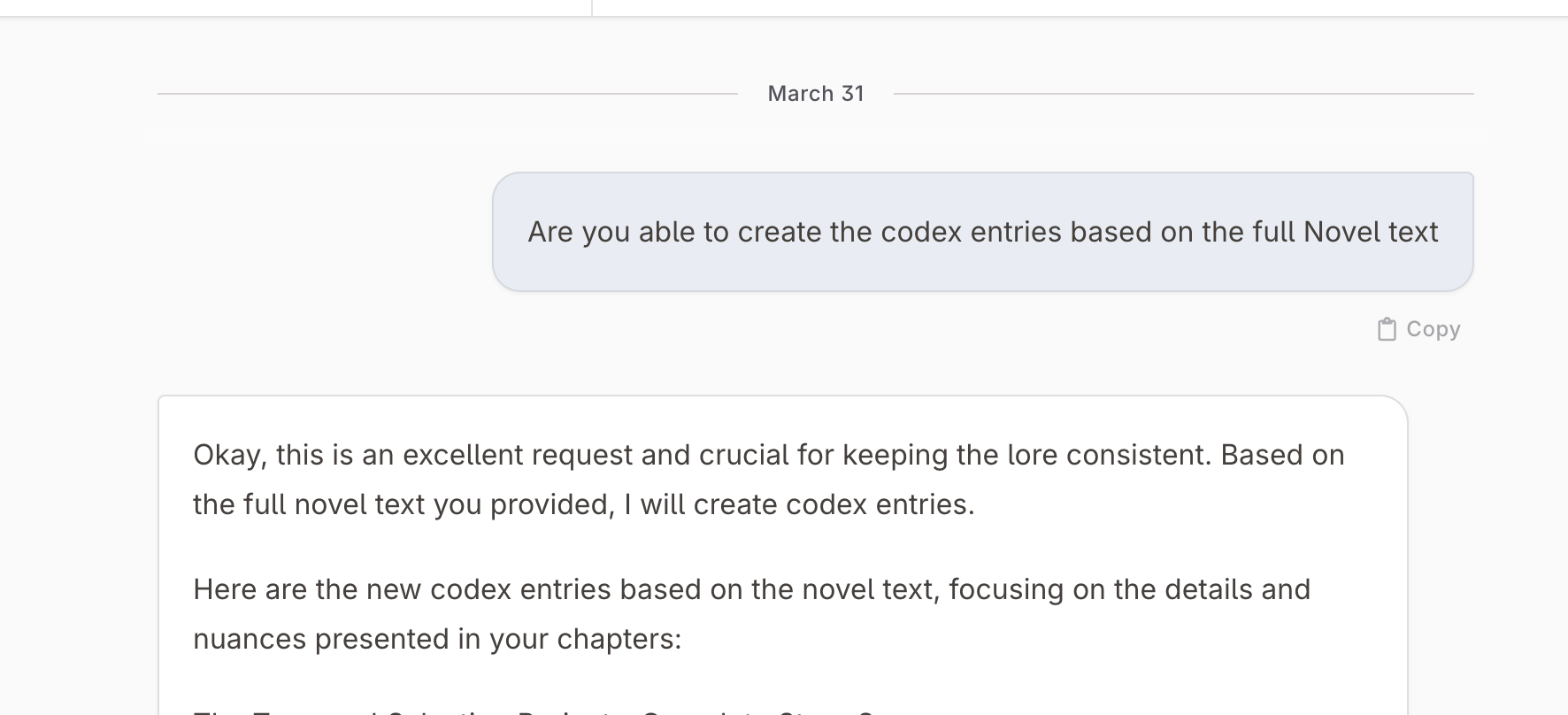
After that, though, Novelcrafter does have significant tooling that Type.ai doesn’t, such as automatic tracking of occurrences of a character in the text.
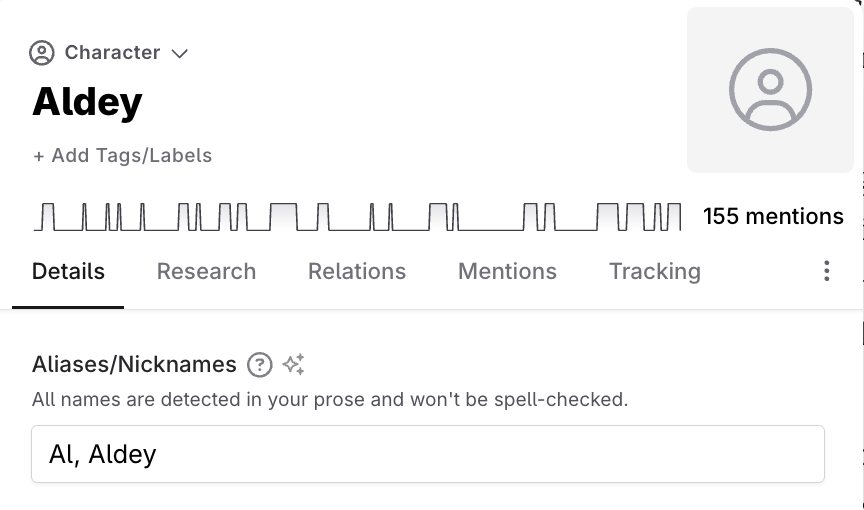
This is a significant trade-off. Type.ai does almost everything that Novelcrafter does with no user effort at all, but Novelcrafter offers some utility features Type.ai just doesn’t have after making a writer do manual labor to enable them. It’s a decision each writer will make differently, depending on need.
Where Type.ai’s long-document focus meant it handled a novel-sized context very well, Novelcrafter’s performance was much more in line with what we’d normally expect from a chat-format platform like ChatGPT or Claude. After uploading the document, the chat assistant seemed confused about what we wanted when we asked for details from deep within the uploaded document:
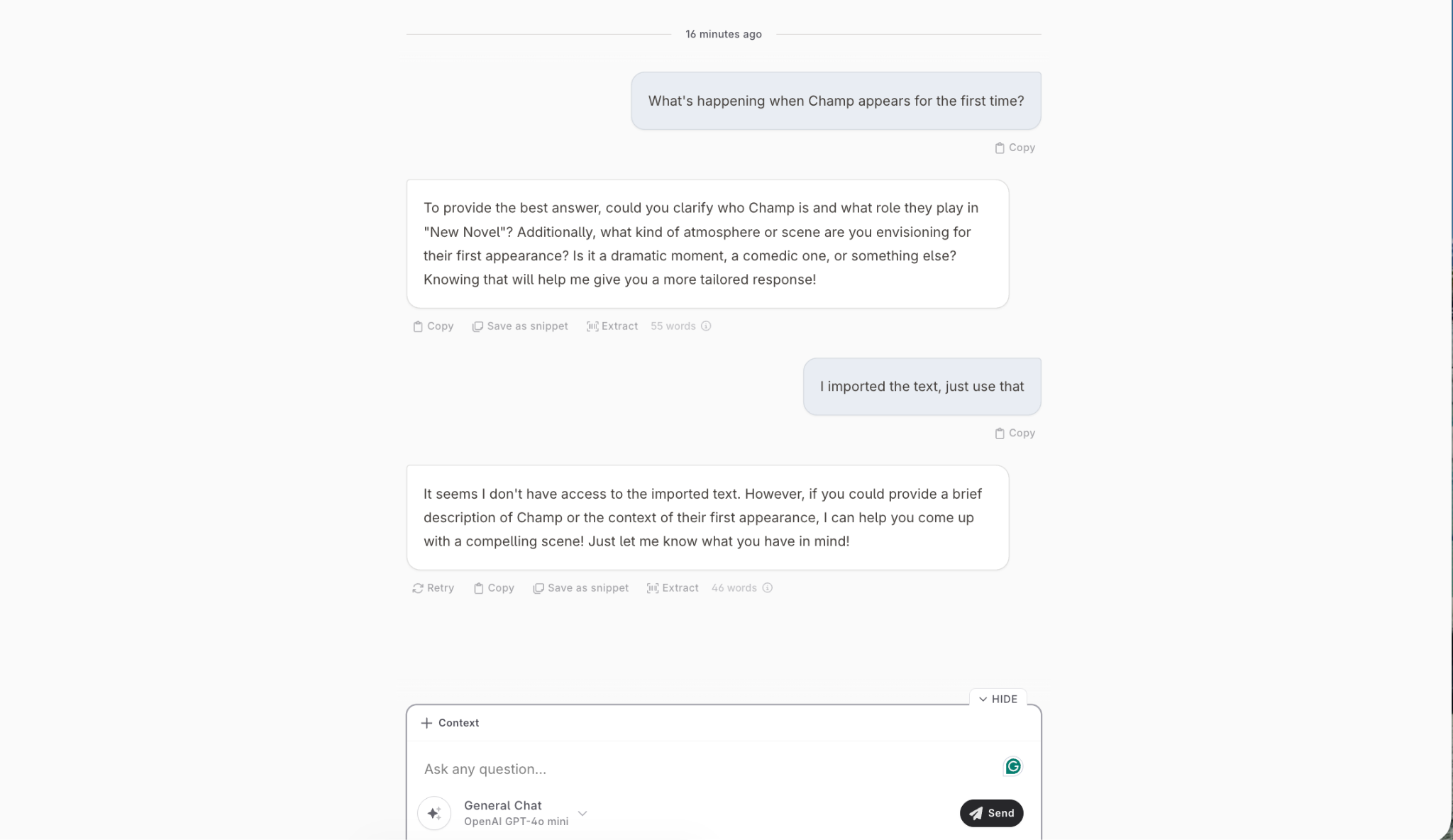
Adding a character to the Codex didn’t appear to fix this.
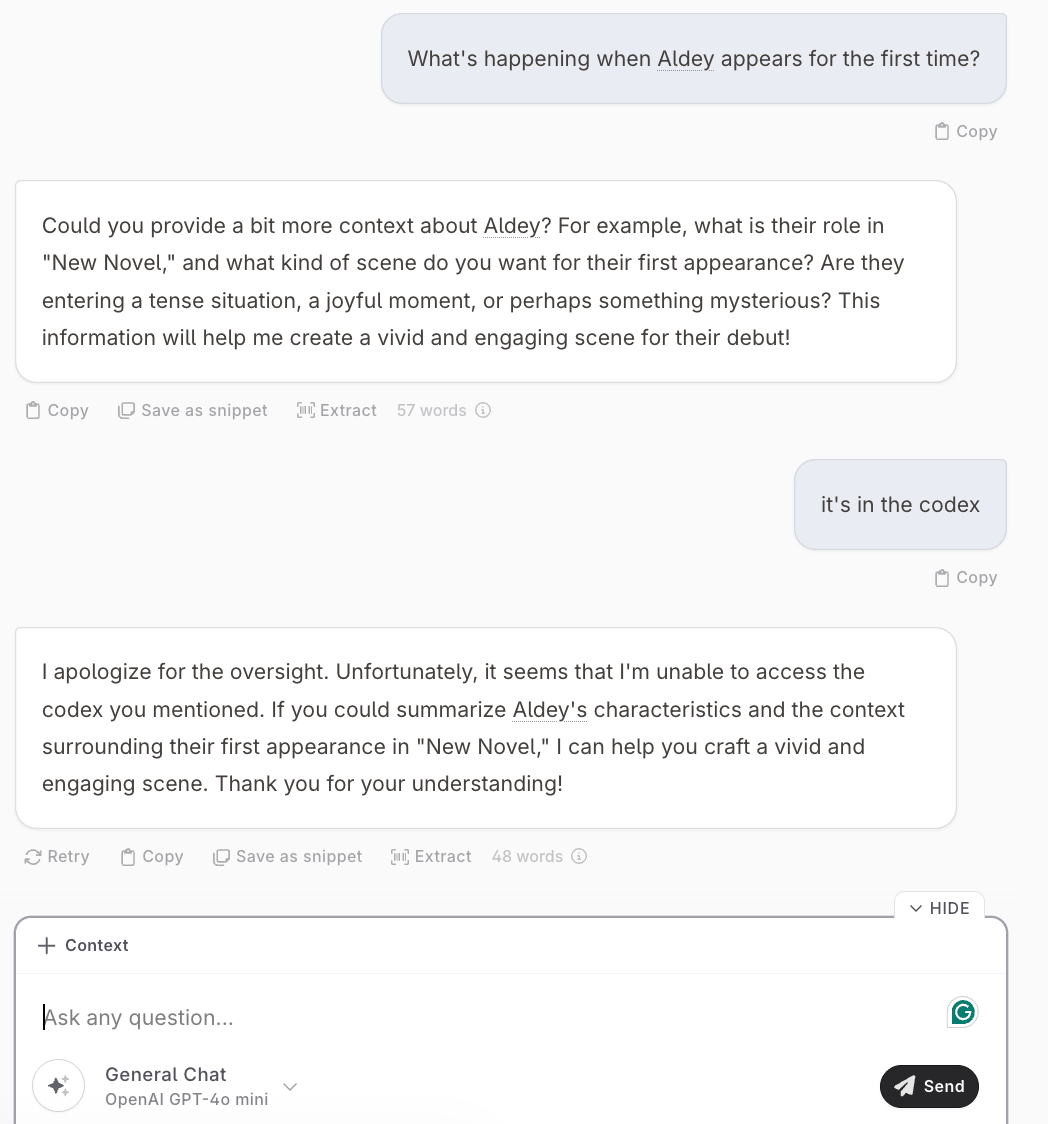
For most users, this is a different expeirence compared to what Type.ai can do. Chat is a way most writers will eventually want to interact with the context of their novels. To be fair, this is a software, and any software can be buggy at times, so there is no blaming here - just simply pointing that this is our experience when we tested it.
Revision Pass
We asked both tools to do a revision pass of the same section of text, requesting that they tighten it without losing voice. We assessed based on two different criteria: Ease of operation and result.
Type.ai
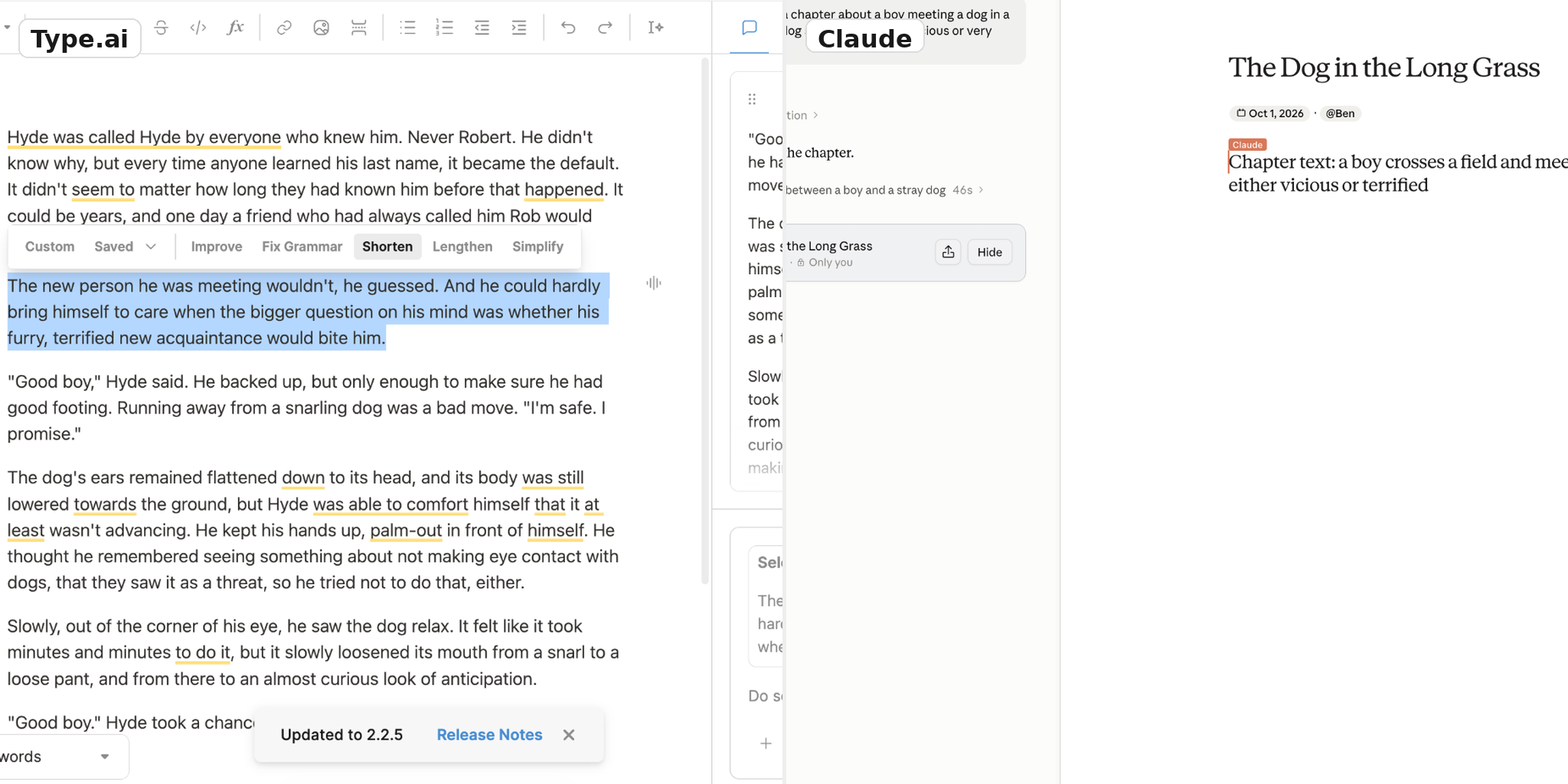
Type.ai’s ease of use passed with flying colors. Not only was it easy to get the program to take a shot at refining, it offered several ways to do this. Highlighting the text and making a chat request, hitting a “shorten” button and using the “improve” button all worked admirably.
In every case, the suggestions were usable and rational. They are also suggestions, individually presented changes that could be accepted or rejected one-by-one.
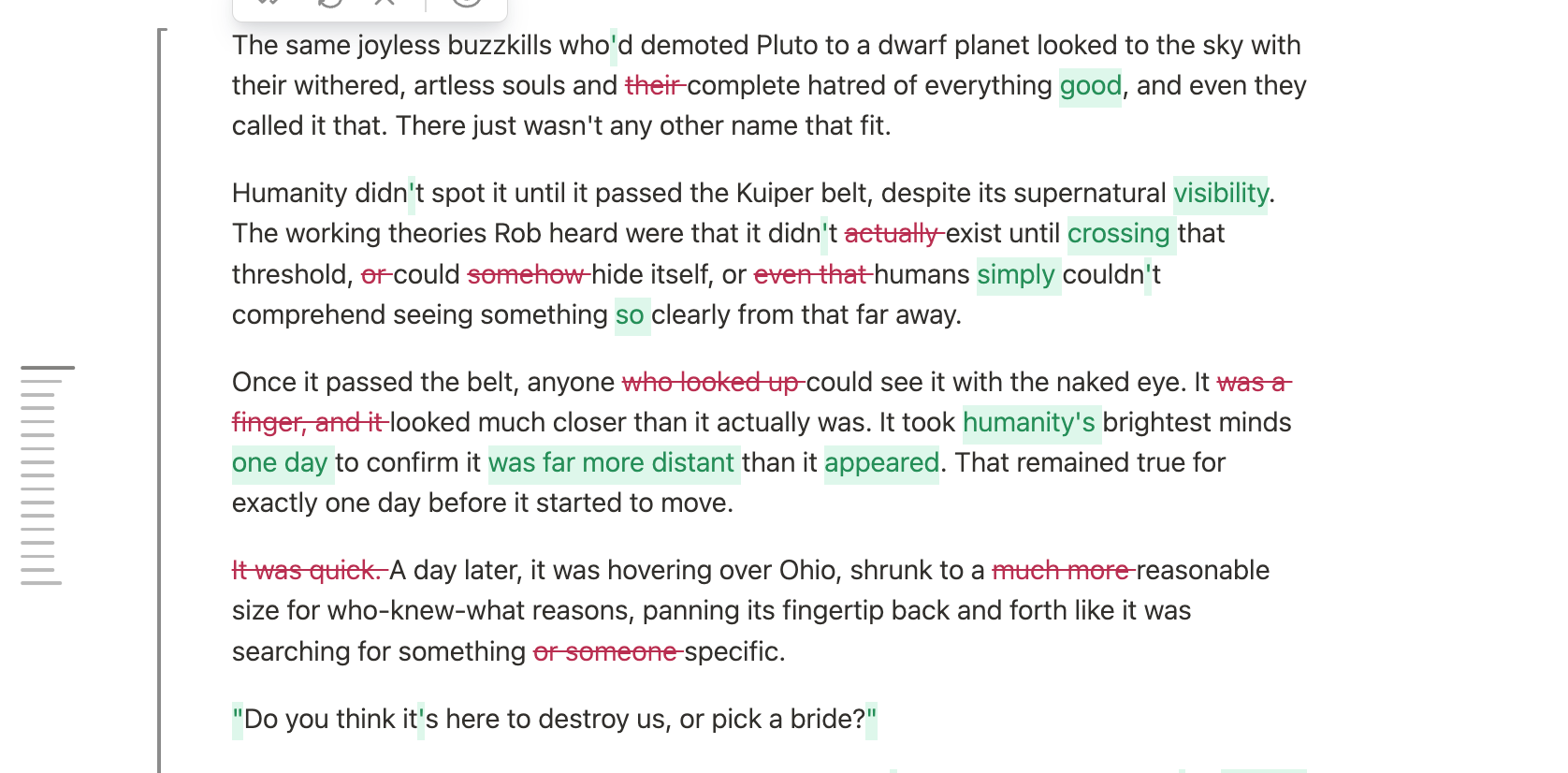
Overall, this is a usable process that works no matter how you approach it; Type.ai makes it impossible to misunderstand how to complete the task.
Novelcrafter
Using Novelcrafter for revisions was not quite as straightforward as Type.ai. The chat function was usable, but required cutting and pasting text we wanted revised into a separate chat tab, where it made suggestions on changes over the text as a whole.
Our options were reduced to either taking every suggestion at once, or manually editing each change into the text via cut-and-paste. Either way, this was extra work and took more time compared to Type.ai.
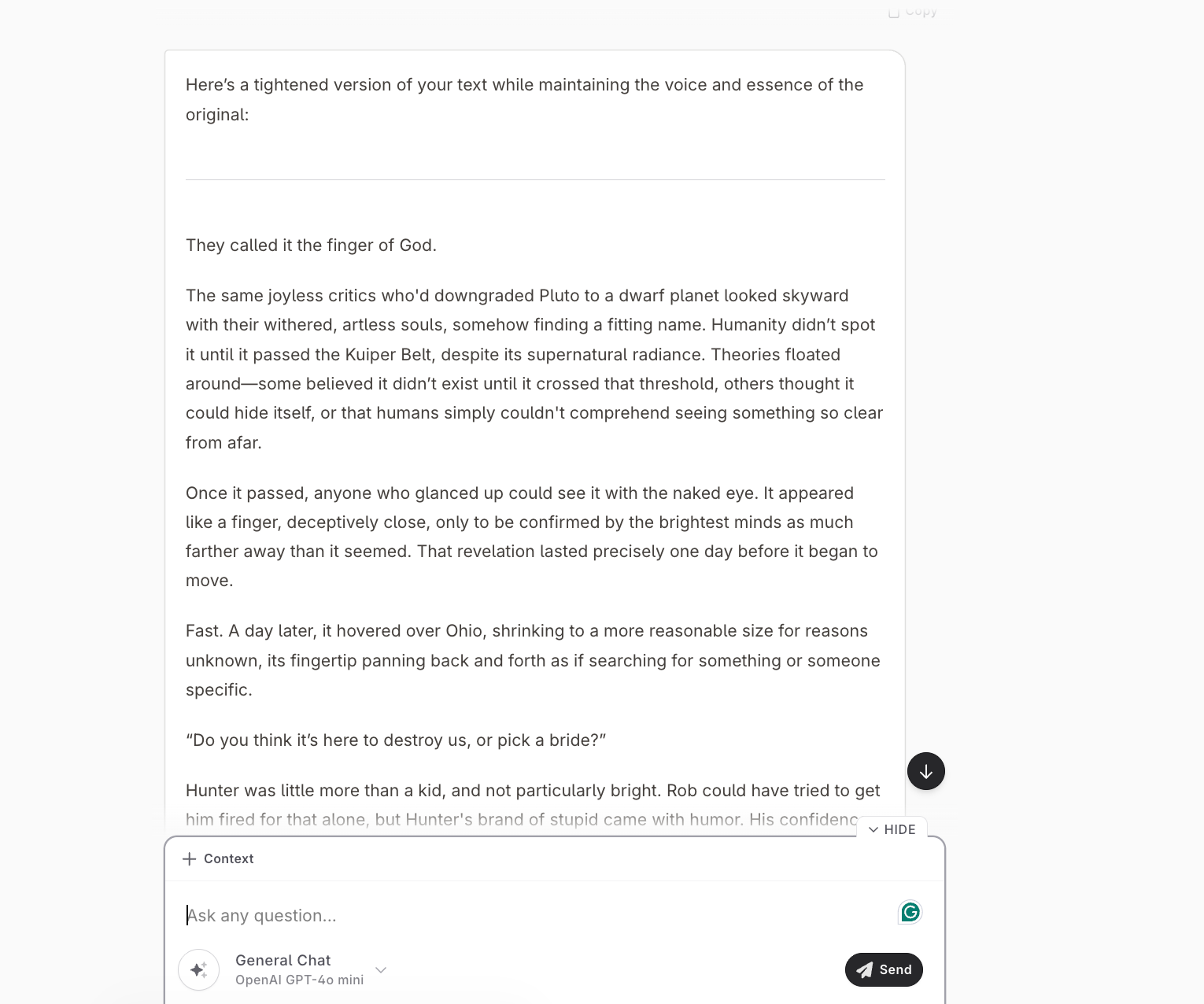
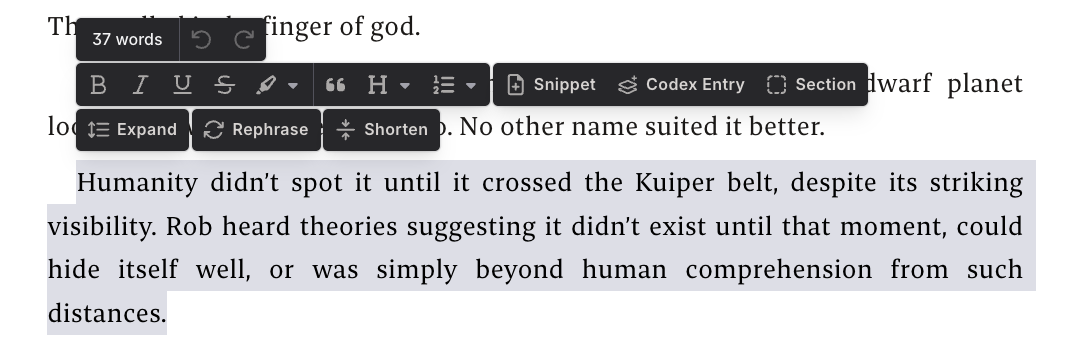
Trying to edit directly within the text was not possible for this test. Novelcrafter offers expand, rephrase, and shorten tools, but even the closest match, “shorten”, is not a dedicated text-tightening tool; it reduces word count to a suggested level, but had little regard for preserving author voice.
Novelcrafter - The Codex Advantage
Novelcrafter’s clear advantage in storybuilding shouldn’t be minimized. With the possible exception of Sudowrite, no tool encourages more deeply realized worldbuilding than Novelcrafter.
Whether it’s a piece of lore, a magical item, a location or a character, Novelcrafter has an entry type for a writer to use that not only allows them to record all the relevant details, but also lets them see where those characters occur in their novel, how they relate to other entries, and generally how they are situated in a changing story over time.
Entering all these details is a definite setup cost, but for an author writing a complex story over an entire novel or a series it’s a cost that might very well prove worth the time. In return for their effort, writers get a fleshed-out “private wiki” on their novel or series. It’s not a bad trade.
Type.ai uses a lighter-touch, more automatic system. As new characters and locations appear in the story, they automatically update into a growing, evolving database that can then be manually edited to just the facts and ideas the author wants to preserve.
These differences highlight noticeably different philosophical approaches. Where Type.ai considers the manuscript the source of truth and updates its story-based Notes feature based on edits to the work, Novelcrafter treats its story bible as a user-filled database that the story draws from. Neither stance is wrong, but different writers will find they have individual preferences regarding each tool’s approach.
If you are a heavy worldbuilder who takes extensive notes, Type.ai’s system is the fast-but-good option; it does a great job, but isn’t the equal of Codex’s sheer depth.
Pricing
Differences of price between Type.ai and Novelcrafter are not simple one-to-one comparisons. Type.ai’s subscriptions are an all-in-one product; Novelcrafter’s represent different tiers of tool capability driven by any of dozens of choices of outside-the-app token purchases from a similar number of AI models.
So while Type.ai’s all-in-one pricing looks like this:
- Basic: $8/month, Pro: $16/month, Max: $64/month (all billed annually)
- Generous allowances of tokens for Anthropic, OpenAI and Google models built into the price
- All tools and functions are available at every level
Novelcrafter’s look more like this:
- The Scribe tier (about $3.33/month, $40 billed annually) lets you use every non-AI function of Novelcrafter’s product, but specifically disallows any AI tool usage.
- The Hobbyist tier (about $6.67/month, $80 billed annually) allows you to integrate your own AI model, enabling (some) AI tools. It also requires at least one separate bill to do so; your token use is a separate, unbundled cost that varies based on the models used and how much you use them.
- Artisan and Specialist tiers (about $11.67/month and $16.67/month respectively, $140 and $200 billed annually).
The Type.ai subscription includes a fixed monthly credit allowance, with optional additional credits available for purchase. Since Novelcrafter’s subscriptions work differently, their “total price” varies quite a bit more depending on which model you use, which tools you want to use, and how much you need to write.
Some very involved, tech-savvy users will potentially save money by using low-cost AI models where output quality isn’t as much of a concern, especially over longer works. All this complexity does buy something, and it’s control: for the writer who knows exactly how to leverage that control, there are real benefits.
Credit Anxiety
The potential for credit anxiety (the fear that you might run out of tokens or credits before your work is through) exists in both tools, but takes different forms. In Type.ai, it mostly has to do with selecting the correct tier. Basic, Pro and Max plans all provide different amounts of tokens, which means monitoring a credit balance and using resources wisely within a particular billing period. Note: Only AI features use tokens; manual writing, importing, exporting and other non-AI features are always available, even after credit limits are reached.
Novelcrafter’s version of credit anxiety hinges on budget. Since you are buying tokens “wholesale”, there’s no tiered limits on how many tokens you can use. Instead, the limiting factor is your pocketbook; you run out of tokens to spend when you run out of money in your bank account, and manage anxiety by balancing your credit spend against your real-world budget.
Trial Options
Free trials look different in both Type.ai and Novelcrafter. Type.ai offers a limited free tier, including a small fixed amount of non-expiring credits. For some light users, this is enough to get a good taste of what Type.ai offers while getting a significant amount of work done, but it’s fundamentally limited. Type.ai also offers a 30-day money-back guarantee on paid tiers, which allows for a different way to evaluate whether or not the product meets a particular writer’s needs.
Novelcrafter’s free trial is different; it offers 21 days of full access to their platform at no cost at all. AI usage is not included in this trial, which means AI tools still cost something to use; still, this is in most ways a more generous way to let users test drive their product compared to Type.ai’s free tier.
Novelcrafter vs Type.ai - Which One for Which Writer
The Discovery Writer/ First-time writer
A discovery writer is trying to figure out who they are as an author and what they want to write as they write it. They want low friction and tools that help them learn about their own style and habits as they write.
Recommendation: Type.ai’s automatic note-taking tools and zero-friction environment help Discovery Writers learn as they go.
Worldbuilders
Worldbuilders want to create complex magic systems, fleshed out governments, and overall deep lore to inform and improve their writing over a novel or a series.
Recommendation: Novelcrafter. Nothing can match Novelcrafter’s Codex for sheer worldbuilding depth.
The Techy Writer
The savvy Techy Writer already understands and has API keys for a variety of AI models, and wants to integrate them into their writing process for maximum flexibility.
Recommendation: Novelcrafter’s pitch is allowing just what we described, at a level no other AI writing tool matches.
Nonfiction or Hybrid Writers
Nonfiction or Hybrid Writers need a different kind of note-taking and content tracking than fiction writers do, wrapped up in efficiency tools that help them write fast, clean text.
Recommendation: Type.ai’s interface works as well for nonfiction as fiction straight out of the box, and their inline editing within a document-first environment can’t be beat. The Notes feature also adds strength by automatically building the pillars of the book automatically.
The Revisor
Revisors are looking for tools that help them edit and refine their work in a quick, efficient way that preserves their voice and message.
Recommendation: Type.ai’s editing tools are best in class, and are built with the express purpose of preserving an author’s voice and role in the creation of their own work.
Can You Use Both?
Yes, and some writers do. For instance, some writers use Novelcrafter entirely for its Codex functionality, or for Codex and automatic, AI-driven text generation. They then draft, redraft, edit and revise in Type.ai. Using more than one tool in this way means they can get the best of both worlds, regardless of which features they prefer tool-to-tool.
This comes at a cost; it means juggling more billing, for one. For most writers it means maintaining two mental models built around which tool does what, and manually syncing work between two AI tools that aren’t built to work with each other without copy-pasting or frequent import/export actions.
While it’s possible to use both and some will find it worth it, most writers are better off choosing just one tool, one workspace, and fewer entries on their bank account statements. Type.ai is the better general choice for this unless you need very detailed worldbuilding help, or controlling your own AI connections matters to you more than an all-in-one option that bundles AI functionality and specialized tools into one subscription fee.
Frequently asked questions
1. What Is the Difference Between Type.ai and Novelcrafter?
Type.ai is a faster, cleaner, and better realized environment to write and edit in. Novelcrafter has stronger worldbuilding tools and lets you use almost any AI model, as opposed to just three best-in-class Anthropic, OpenAI, and Google models.
2. Does Novelcrafter Include AI, or Do I Need My Own API Key?
Novelcrafter does NOT include AI in any of its tiers. Authors who want AI tools instead provide access to their accounts in different AI models, paying for whatever tokens or credits they use separately.
3. Which Is Cheaper, Type.ai or Novelcrafter?
Novelcrafter has the lowest-priced base tiers, but does not include AI tokens as Type.ai does. Type.ai bundles credits with its subscription; Novelcrafter adds variable provider charges to its subscription, so the cheaper total depends on usage.
4. Does Type.ai Have a Codex or Story Bible?
Type.ai’s Notes feature automatically extracts details about the story as you go, fleshing out an ever-growing database containing characters, places, settings, and scenes. It’s easy to use, fast, and mostly automatic, but not as in-depth in absolute terms as Novelcrafter’s Codex.
5. Is Novelcrafter Hard to Learn?
At minimum, Novelcrafter requires you to have a separate account with an LLM provider, and to know how to set up their tool to use it. None of this is incredibly difficult, but most users simply want access to the most powerful recent models. Since Type.ai comes with these prepackaged, Novelcrafter is at least harder to use in a way that only makes sense for certain tech-savvy users.
6. Can I Run Local Models with Novelcrafter?
Yes. Some users run LM Studio and Ollama locally. Type.ai does not offer the same kind of local-model choice.
7. Which Is Better for Writing a Novel?
Type.ai is better for most users. It’s a more efficient, better built interface for writing books which requires almost no setup and comes pre-bundled with powerful AI models. Novelcrafter is better for users who need more story-building functionality beyond what Type.ai’s Notes feature can provide, or that need API-key level control of model choice.
8. Which Is Better for Nonfiction Books?
Novelcrafter is fiction writing software first — the Codex, scene planning and plot-point tools assume a story. Type.ai is general-purpose AI writing software that handles long-form fiction, nonfiction and business writing in the same document-first workflow.
Fiction authors sometimes get more from Novelcrafter’s structure; writers who move between genres are better served by Type.ai.
9. Can Type.ai Handle a Full-Length Manuscript?
Yes. Type.ai supports document sizes up to 150,000 words, much longer than a typical novel’s length.
10. Does Either Tool Have a Free Plan?
Type.ai has a free plan; Novelcrafter has no free plan but does offer a time-limited trial. Type.ai offers a fixed amount of non-expiring credits to give users a taste of their product, while Novelcrafter gives a 21-day trial that offers complete access to their tool, but not the AI tokens needed to use its AI-driven features.
11. Can I Switch from Novelcrafter to Type.ai and Bring My Manuscript?
Yes. Type.ai has robust import/export features that make bringing a manuscript easy. Since Type.ai supports document sizes up to 150,000 words, you can import documents up to that size cleanly with all their formatting preserved.
Codex entries do not transfer in the same way. Type.ai’s Notes feature will automatically build context similar to what Codex contained, but some level of rebuilding will be required if you want to replicate 100% of what youf had.
12. Type.ai vs Novelcrafter: Which Is Better for Discovery Writing?
Writers whose creative process starts with a blank page instead of an outline will usually prefer Type.ai. It’s a straightforward fit for anyone who wants to start writing immediately with every AI tool they need to move fast within easy reach of their workflow. Since discovery writers find the story through the writing process, speed and efficiency mean they find it faster with Type.ai.
Novelcrafter also supports that process. While a big part of Novelcrafter’s pitch is story bible tools, they are optional, not a prerequisite.
13. How Does Novelcrafter’s Codex Help with Character Consistency?
Think of the Codex as your story’s private wiki: a structured database of character descriptions, locations, relationships, and lore. That structured data can inform AI generation and reduce redundant data entry in your AI prompts. It helps support character consistency, but it does not automatically eliminate plot holes. Its usefulness depends on the entries you maintain and the context supplied to the model.
14. Does Importing a Whole Novel Guarantee Long-Form Consistency?
Not necessarily. On any given platform, context window size matters; if a platform isn’t built to deal with 100,000+ word novels, it will often have trouble remembering specifics and keeping facts consistent chapter-to-chapter. Type.ai supports document sizes up to 150,000 words, which means that it can provide a high level of consistency over novel-length works.
Novelcrafter also performs well with long documents, in a different way: it relies on its Codex feature to provide it with usable context to guide its writing process.
15. Does Novelcrafter Have a Steep Learning Curve?
Novelcrafter requires more setup than Type.ai, but isn’t necessarily difficult to use once the initial set up is done. API key setup and context-tool use are both extra time commitments in Novelcrafter, but they also both provide additional usefulness to some users. Whether or not the additional steps are “worth it” will vary based on how much models choice flexibility and worldbuilding depth an individual writer wants.
16. Which Offers a More Distraction-Free Writing Environment?
Both Type.ai and Novelcrafter try to keep the manuscript you are working on accessible at all times, but “distraction-free” means different things to different writers. Type.ai focuses on centering the manuscript and making sure it’s never out of view, while sometimes using a Novelcrafter feature means navigating to a different tab, completing work there, then navigating back to your document.
One isn’t necessarily better than the other; they are simply different design philosophies built out with different kinds of workflows in mind. Your best option is trying both and seeing which appeals to you more.
Both aim to keep the manuscript accessible, but a distraction-free writing space means different things to different writers. Type.ai bundles AI access into its document-first workflow. Novelcrafter exposes more story-planning and model controls. This reflects a fundamentally different philosophy about convenience and configuration—not writing quality. Prolific writers may prefer either approach, depending on which decisions interrupt their concentration.
17. Can Type.ai or Novelcrafter Handle Final Formatting and Publishing Prep?
It depends on how in-depth your needs are. Both tools have formatting functions and various ways to export the work, but specific authors often have specific needs that go beyond what either tool does by default. The chat assistants in either tool can do a good job of checking for consistency and helping you adjust formatting, but they can’t replace human overview to make sure everything is up to publishing standards.