Can AI actually write a book? (the honest answer)
There are a lot of competing stories about how well AI works for writing books. Some versions say you can enter your ideas and thoughts on the book into a prompt, chunk a lever, and get a fully formed novel in an evening, or a week, or a month, depending on how slow you take it. Other people call the output of that kind of process slop, and say AI is good enough for editing on the spellcheck and grammar level, but nothing else.
So which is it? The truth lies somewhere in the middle. First, the era of AI being undetectable is over. The average person can “hear” the raw voice of AI models in unedited work, and many of them don’t like it. Publishers, when they catch it, often reject 100% AI work.
Yes, AI Chatbots can spit out a lot of words. Yes, they can out-write some people, especially non-writers who haven’t trained. But now that everyone is spitting out work via AI, the baseline quality and voice of AI have become a commodity that’s flooding the market. Amazon got hit first, and now demands disclosure on KDP; readers know this is powerless, and the backlash to endless same-sounding AI novels has been significant.
What AI actually delivers is more limited than “writes a whole book for you”. It allows you to accelerate some aspects of your work, so long as you stay a part of the process to enough of an extent to ensure your own voice flows through, not the AI’s. It can help you edit as you go, and can help you brainstorm, both of which speed up the process from something like “years” to something more like “months of steady progress”.
But it can’t ever replace an author, how they sound, and what they themselves would say. That’s still up to you.
Why chat windows and book generators both fail at book length
Chat windows and book generators both have a big problem: Context. In AI terms, a context window is all the things an AI can try to keep in mind at once, its immediate, uncompressed frame of reference. The bigger the context window gets, the more informed an AI is about what it’s doing, but the sheer size of a large context window makes the AI move slower and spend more tokens per task.
Because of that, AI chatbots tend to “compress” context as they go, making the amount of things they have to keep track of fewer by squeezing down the history of a conversation to a reasonable size.
This works OK for some tasks, but it’s poison for a novel. In a story, every new sentence relies on an understanding of every sentence and paragraph that came before it. When your AI window compresses the story that came before what it’s writing down to a few paragraphs of summary, it loses all the flavor and detail that was built in. Books become aimless messes under those circumstances.
One-shot book generators fail for this reason, but not only that. When you try to put the entire concept of a book into a single prompt, the result an AI will spit out is the best it can do with that much context - an average effort for an LLM model, which isn’t good enough for today’s audiences. They’ll call it slop.
This only gets worse when it loses track of even that limited starting point of context you provided, gets repetitive, and drops the voice you asked it to maintain. Today’s AI-assisted work simply needs heavy human involvement to be good. Set-it-and-forget-it apps are still making promises they can’t keep.
How to write a book with AI in Type.ai — step-by-step
How do you go about maintaining that level of involvement with an AI tool? We chose Type.ai for this demonstration not only because it’s powerful, but because its custom fit for the kind of writer-first, human-involved process we’ve been talking about.
Here’s how to get started in Type.ai in a way that will carry you through a whole novel, piece by efficiently crafted piece.
Voice
Setting up your preferred voice in Type.ai is a great first step that some people put off until later, and that’s a shame. If you are planning on having the AI assistant revise or generate any of your text, giving it the best possible impression of your writing voice from the beginning saves a lot of time and pushes quality levels up.
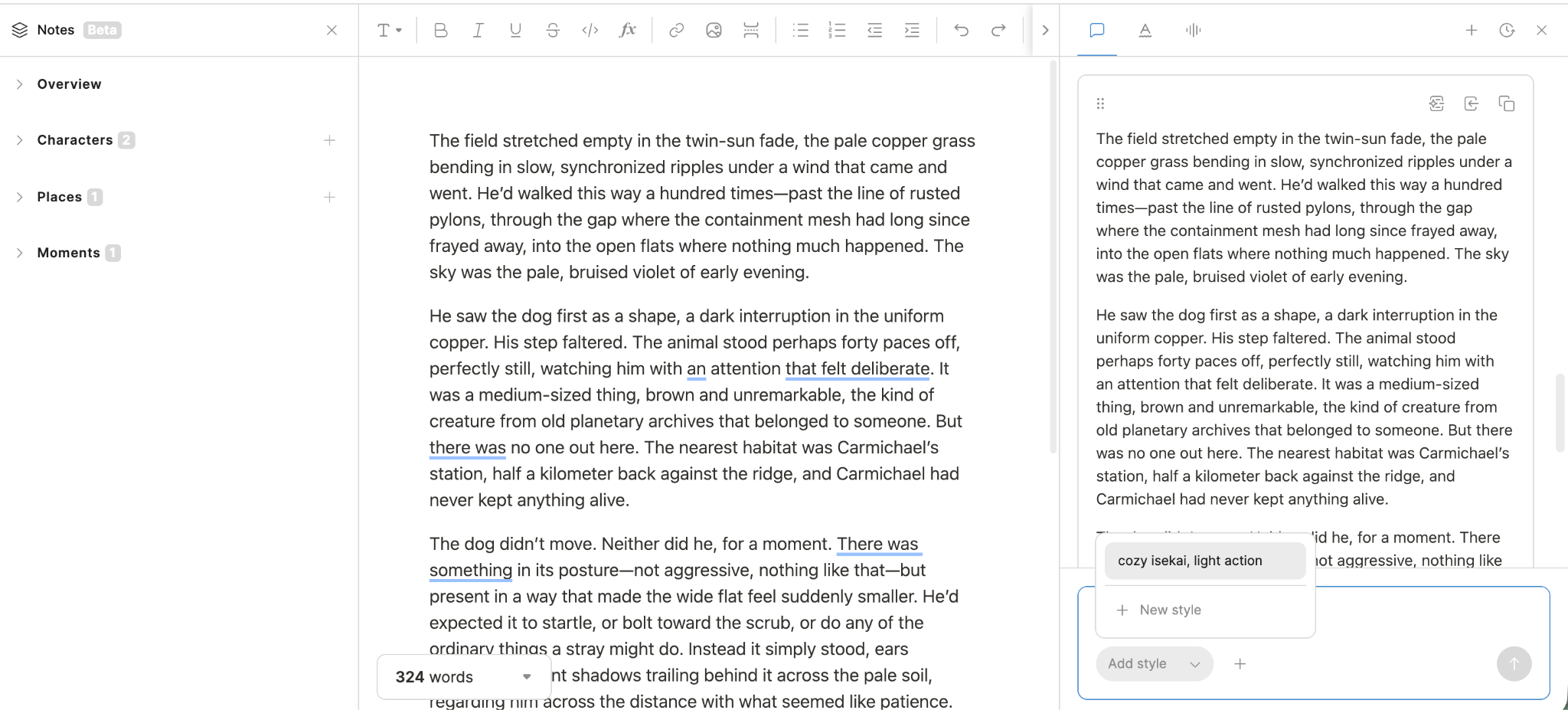
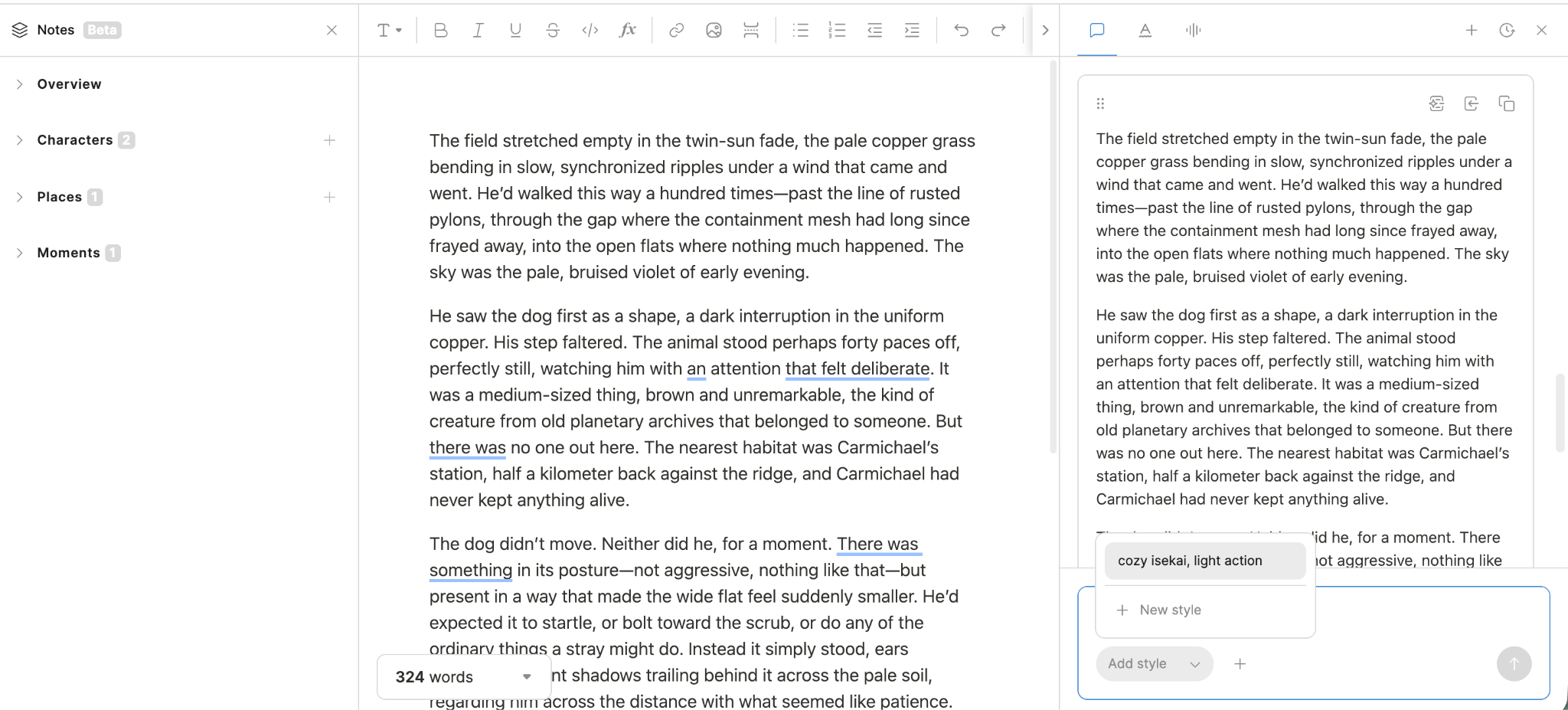
Type keeps the mechanism to edit your style at the bottom of every AI chat, where you can’t forget it and where it can be easily accessed as you fine-tune your voice over time. In the example above, you can see we already have a writing style preloaded from a previous project (styles follow you project to project, instead of disappearing); we could always reuse that, but for this process we want something new.
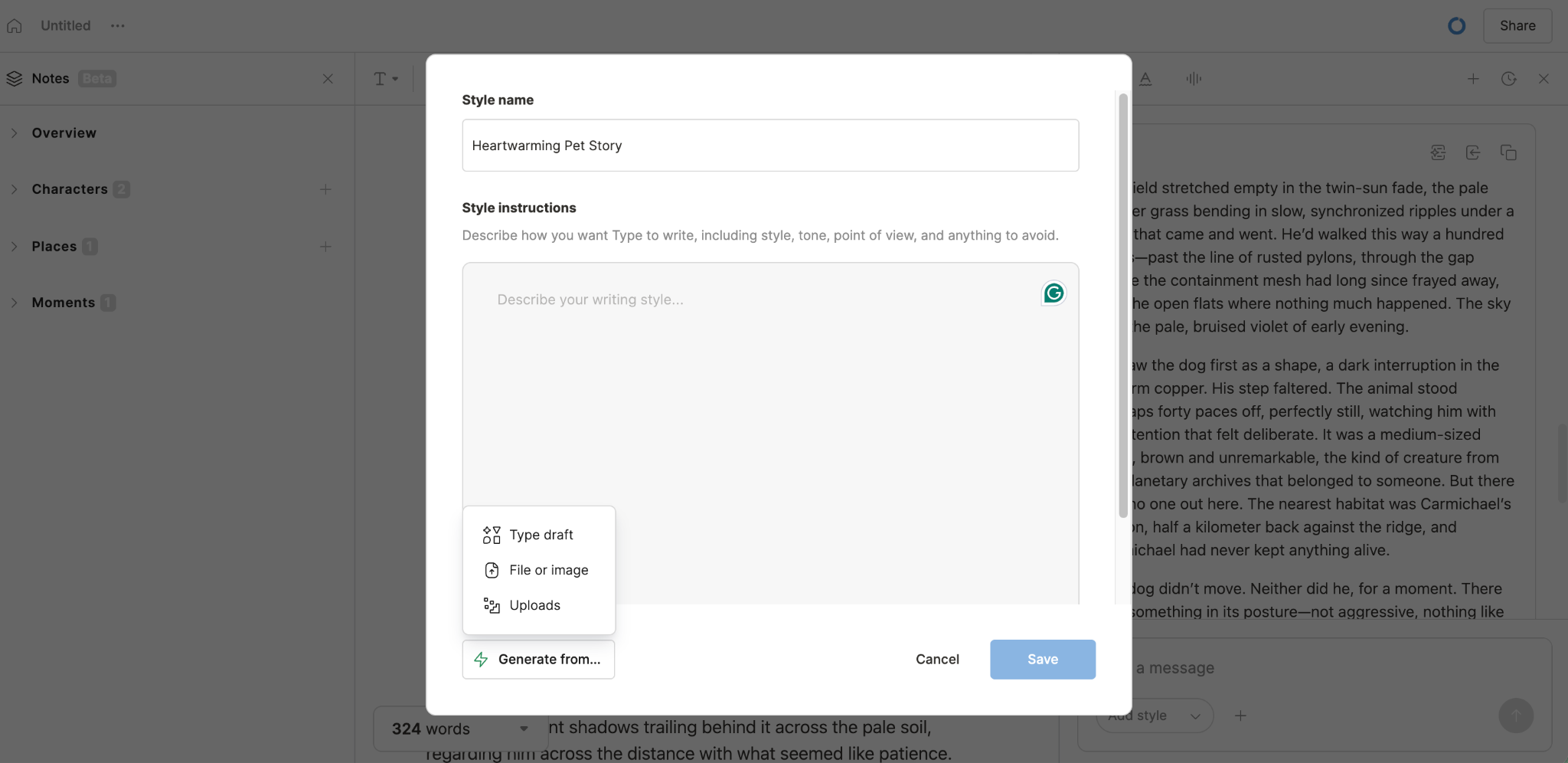
Type allows for a few ways to create your style. The first is typing it out as a set of verbal instructions, an entirely new set of words to guide the project. Other options are more automatic. You can, for instance, write for a while, then ask Type to analyze your voice. You can give it a previous project and have it draw guidance from that. We’ll be doing that last for this project, to give the most possible context to the piece.
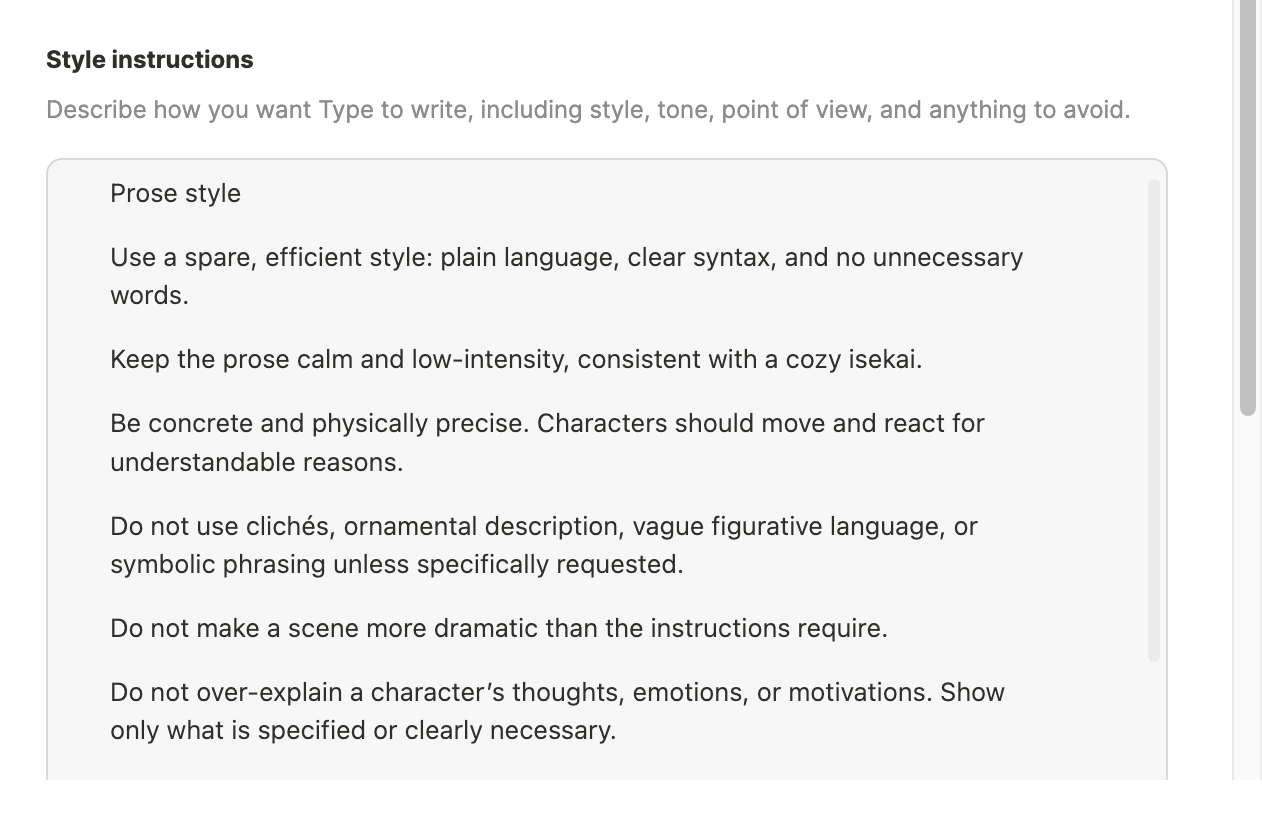
Doing this generates a long summary of how you want to write, but the best results don’t come from having the AI do that and then abandoning the process. It makes its best guesses, which are good enough to save a lot of time. A good author will then get their hands dirty taking the good AI output and making it perfect, just as they eventually will with the body of the book itself.
Brainstorming
Now that the AI has an idea of how you want to write, it’s time to use the AI and your own inspiration to decide what and how to write. From the front page of Type’s interface, we tell the AI we want to do just that:
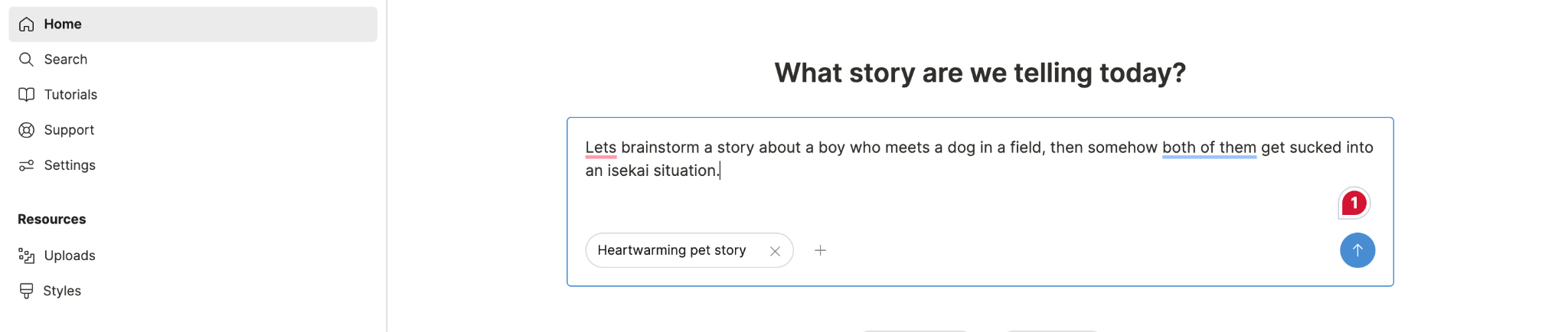
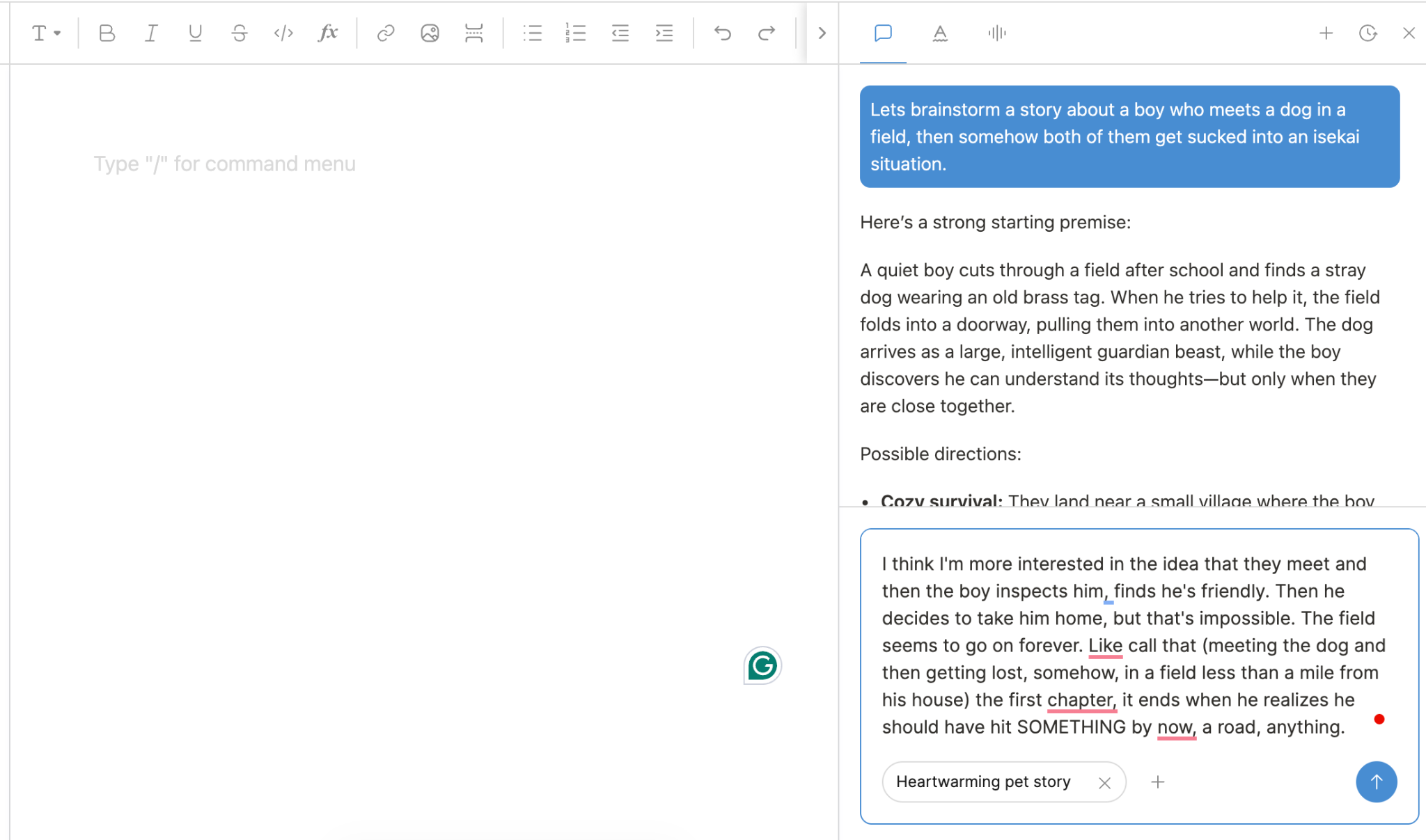
That starts our process. The AI immediately starts doing its best to give us guidance, but it’s still our book. So we counter - that’s a good idea, we say, but what if it was this? That’s important for keeping your voice in the book, for making sure it’s your story and not dead-in-the-water AI average.
Now we keep going. Note we aren’t writing yet, exactly; this is planning, brainstorming. But the entire time we are doing it, Type.ai keeps track of the outline, as on the left here:
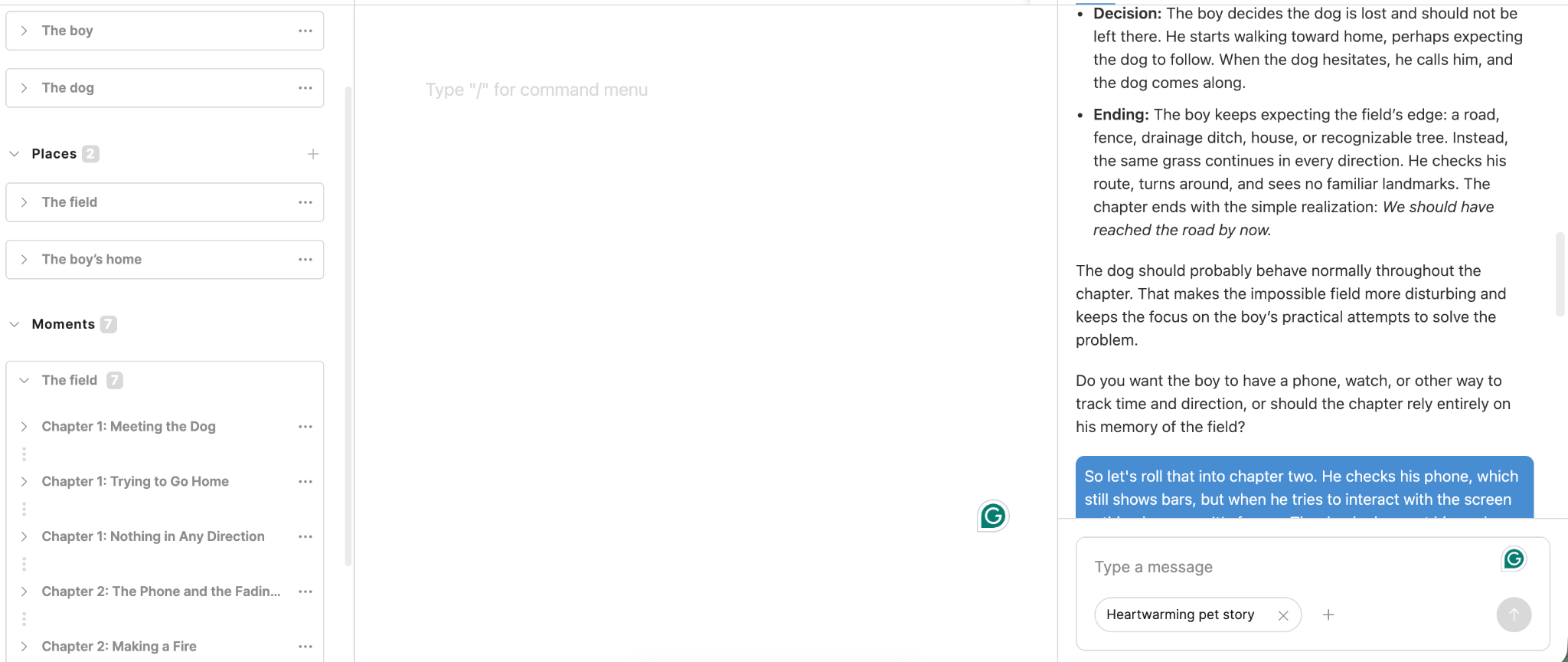
Theoretically, we could go forward chapter by chapter, planning each rung of the ladder of our story from first until last. But for now, we have enough to move on with.
Writing and Editing on the Fly
The first way to do this is the old-fashioned way, getting into the work right away with your own words and your own direction, as here:
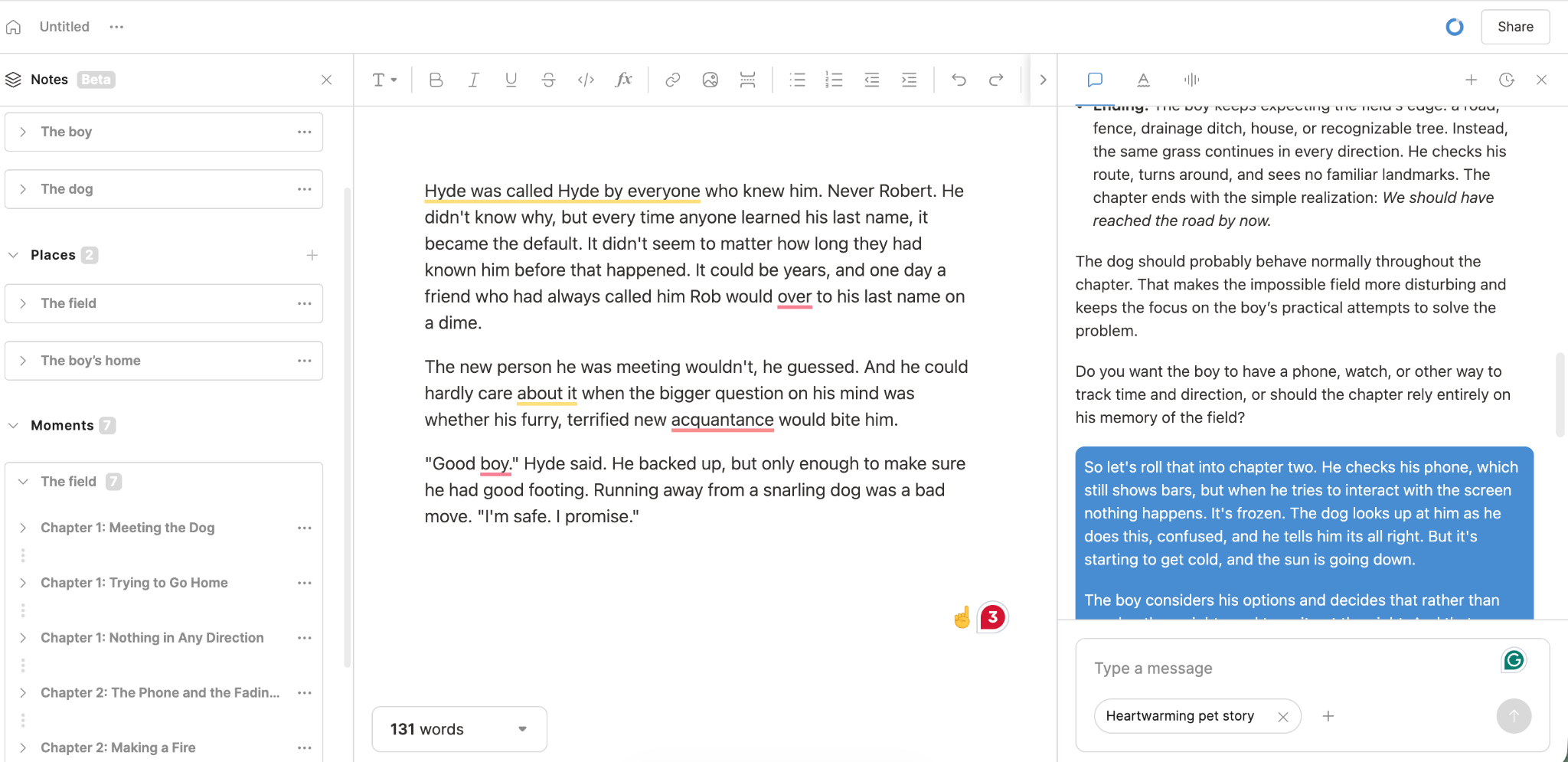
And that’s pretty good, but is it good enough? It might be too wordy, or the grammar might fall apart in places. At any time, you can check by simply highlighting the text and asking it to check. Here’s what happens when we leverage the “improve” function on what we’ve written so far:
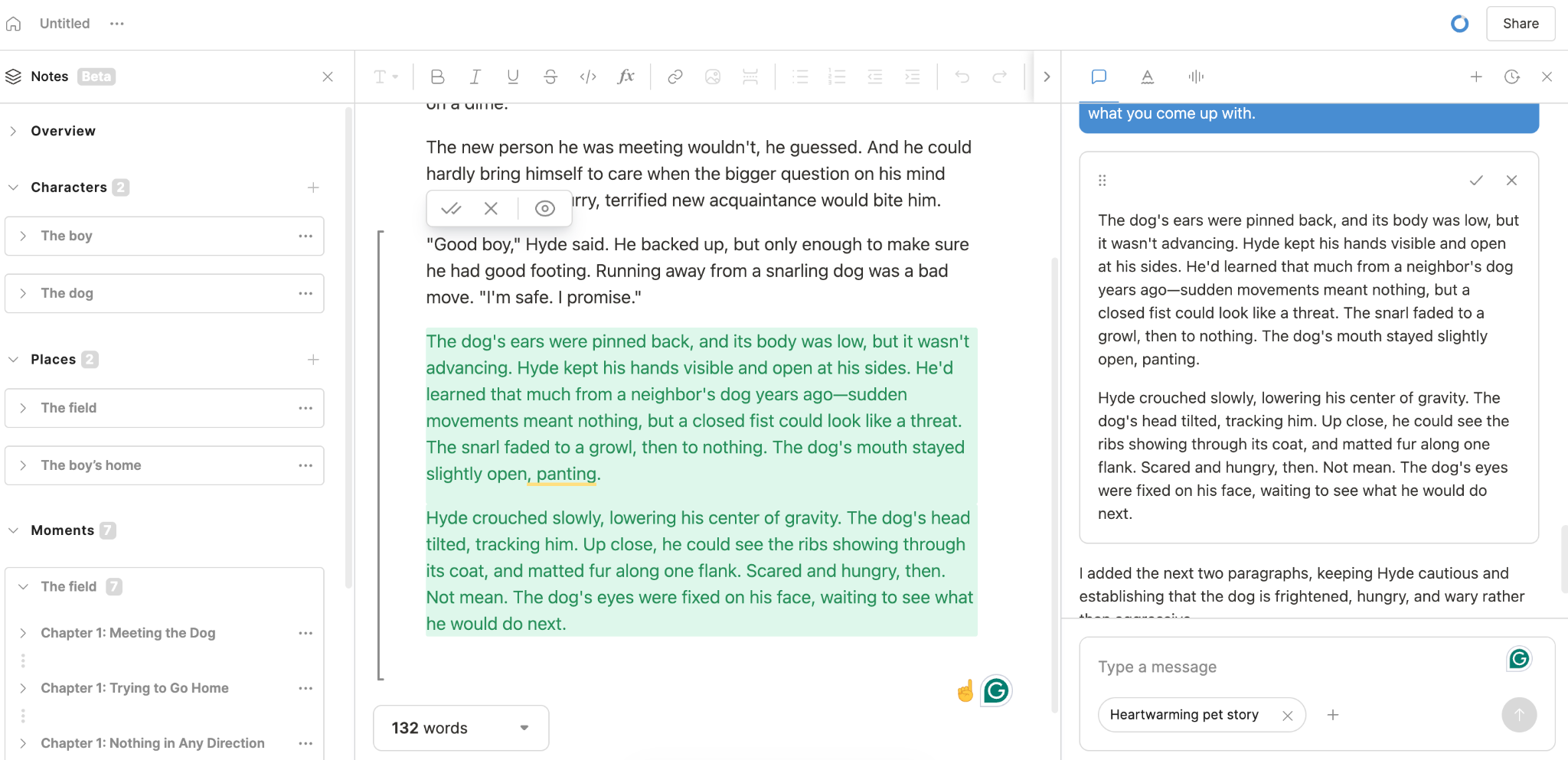
The green section represents what the AI is proposing, just as it did when it proposed changes to improve sentences. We can accept or reject these changes as we see fit, and then edit. Now, there are good things about this section, but there are also things the author might think could be better. So we accept the proposal in this case, but then get down to making it our own.
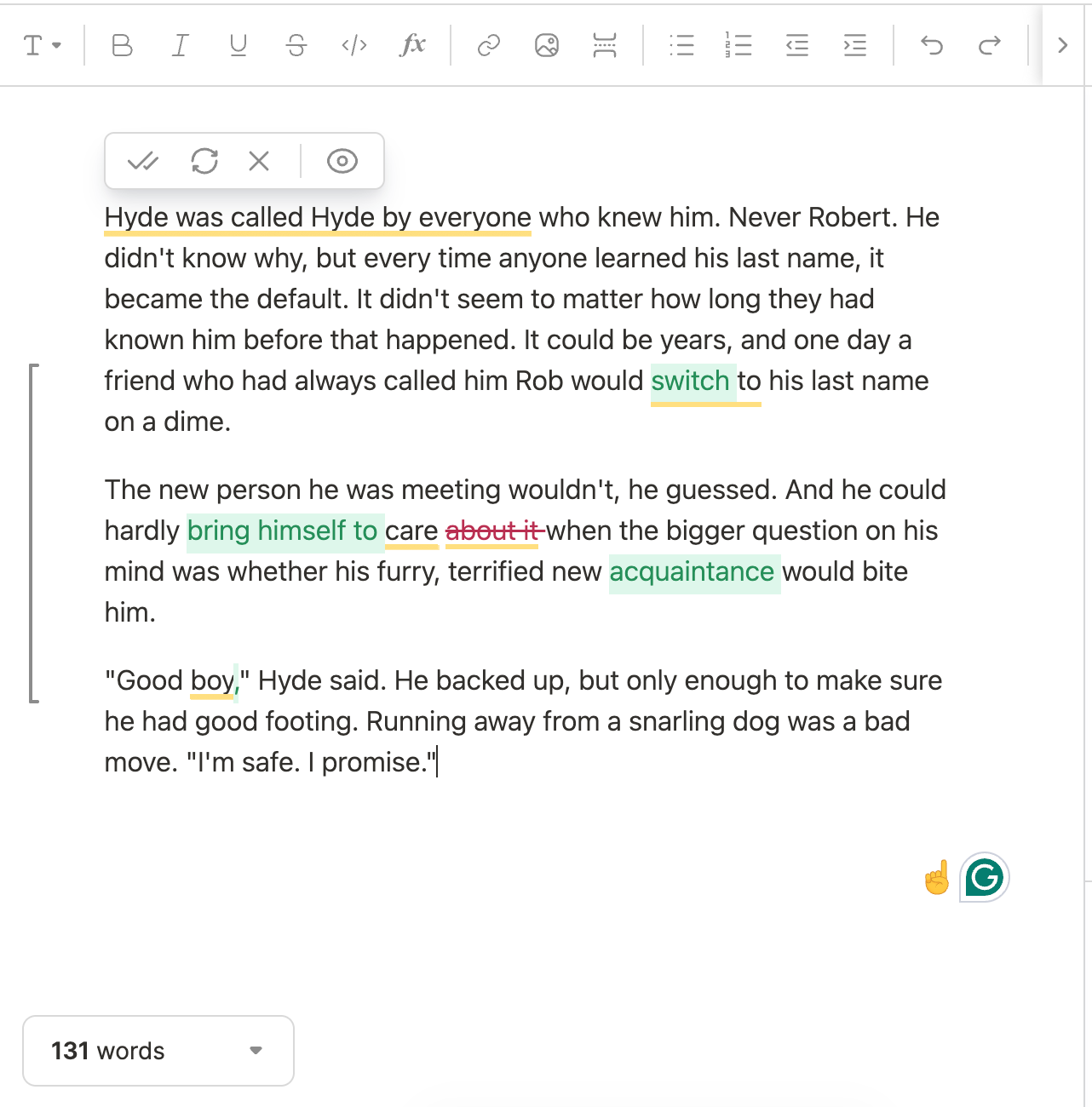
The AI-powered interface finds places where your wording is perhaps a little awkward, as well as typos and grammar mistakes. But note what it doesn’t do, which is just as important: These paragraphs are still very much just an edited version of what a human wrote. The story is still the author’s, full stop.
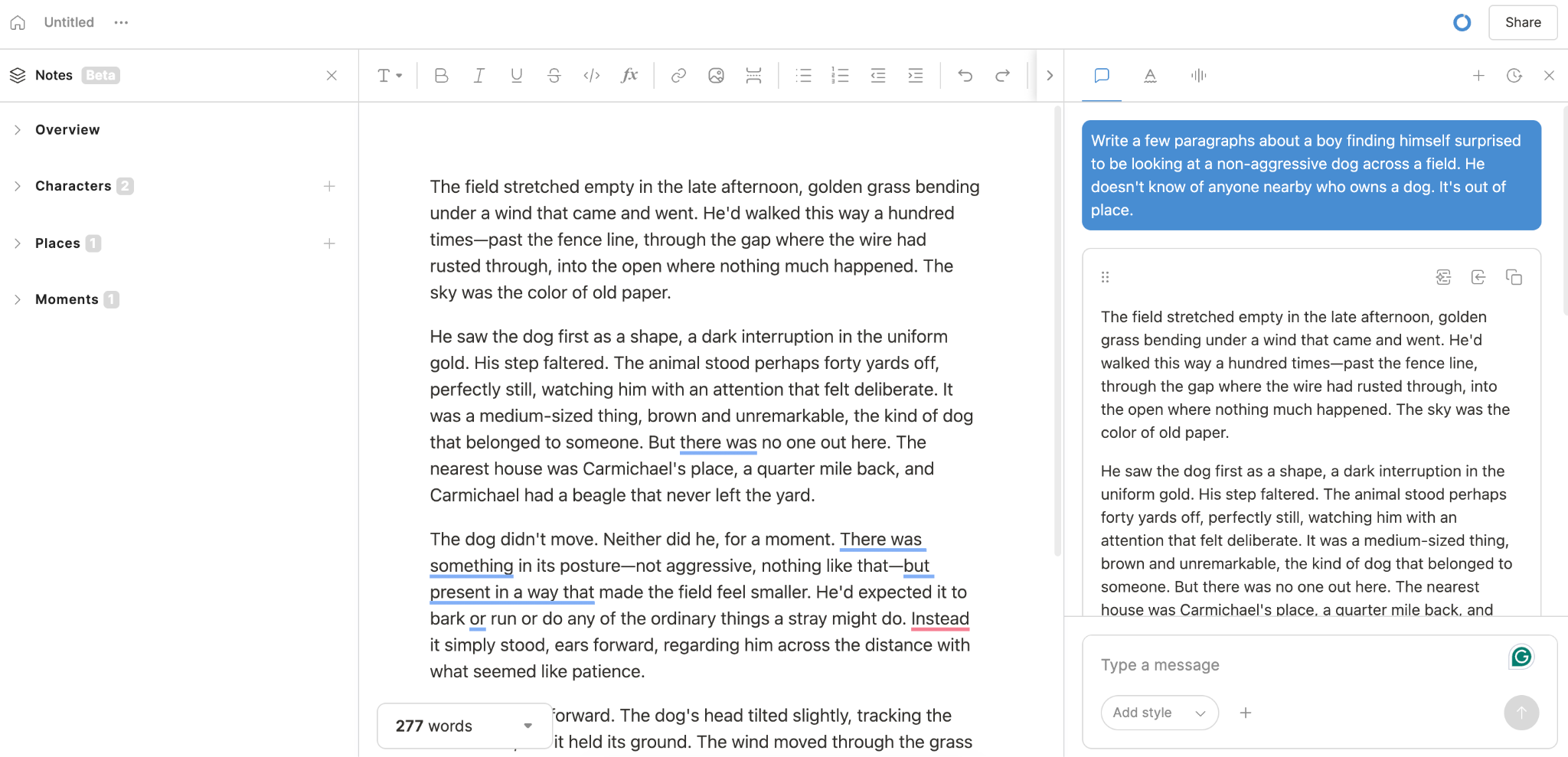
Now let’s consider what this would look like if we had writer’s block, or if we simply wanted to get an idea of how the AI would approach the next section. Let’s let it take the steering wheel for a moment, for just a few paragraphs, and see what it comes up with.
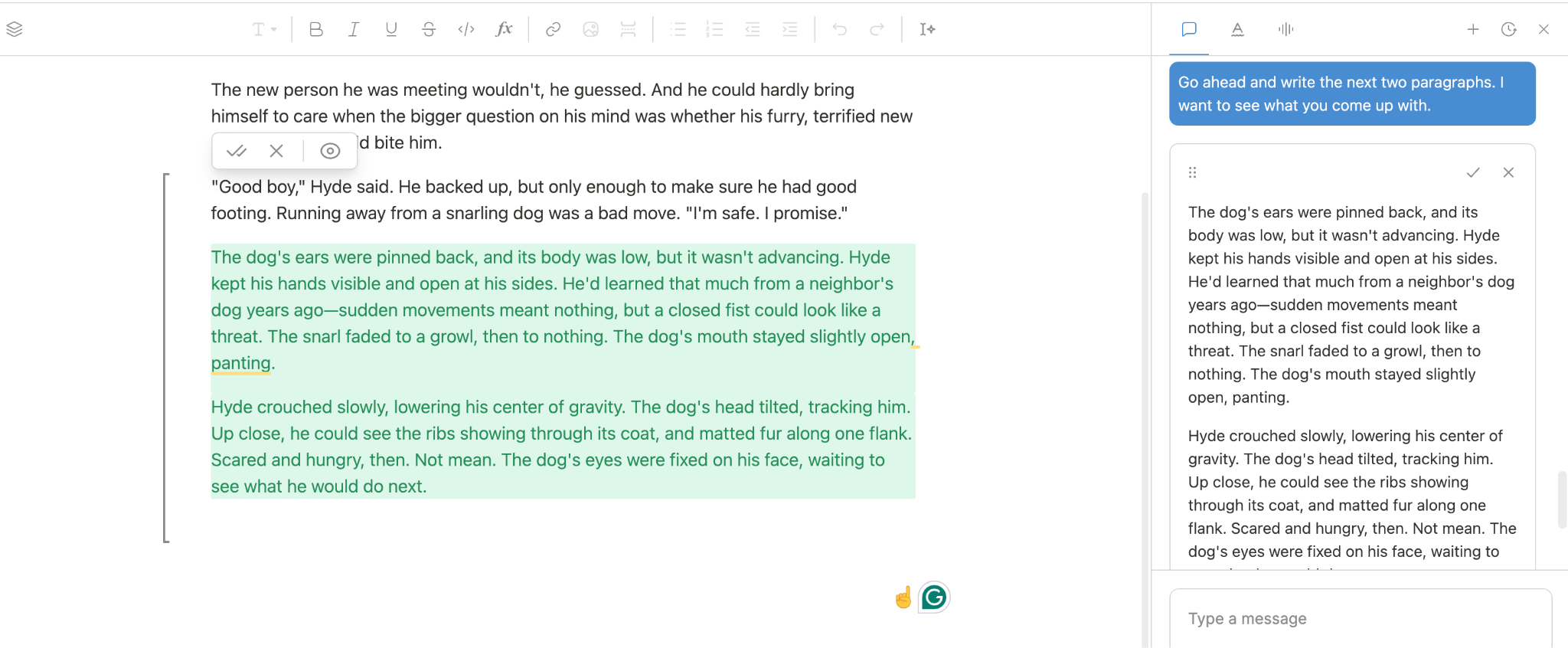
The green here means the same thing it did before during our edit process - we have the choice to accept or reject here. Going through iterations with the chat interface at this stage can knock a lot of the rough edges off before we actually accept a final version.
What we get if we accept this as-is is pretty good, but not perfect. Us being humans, we have the right to alter it, to make it ours. Not only that, the work will thank us for it; again, AI can only do so much. Right now, our piece is missing. When we add it, we get something like this:
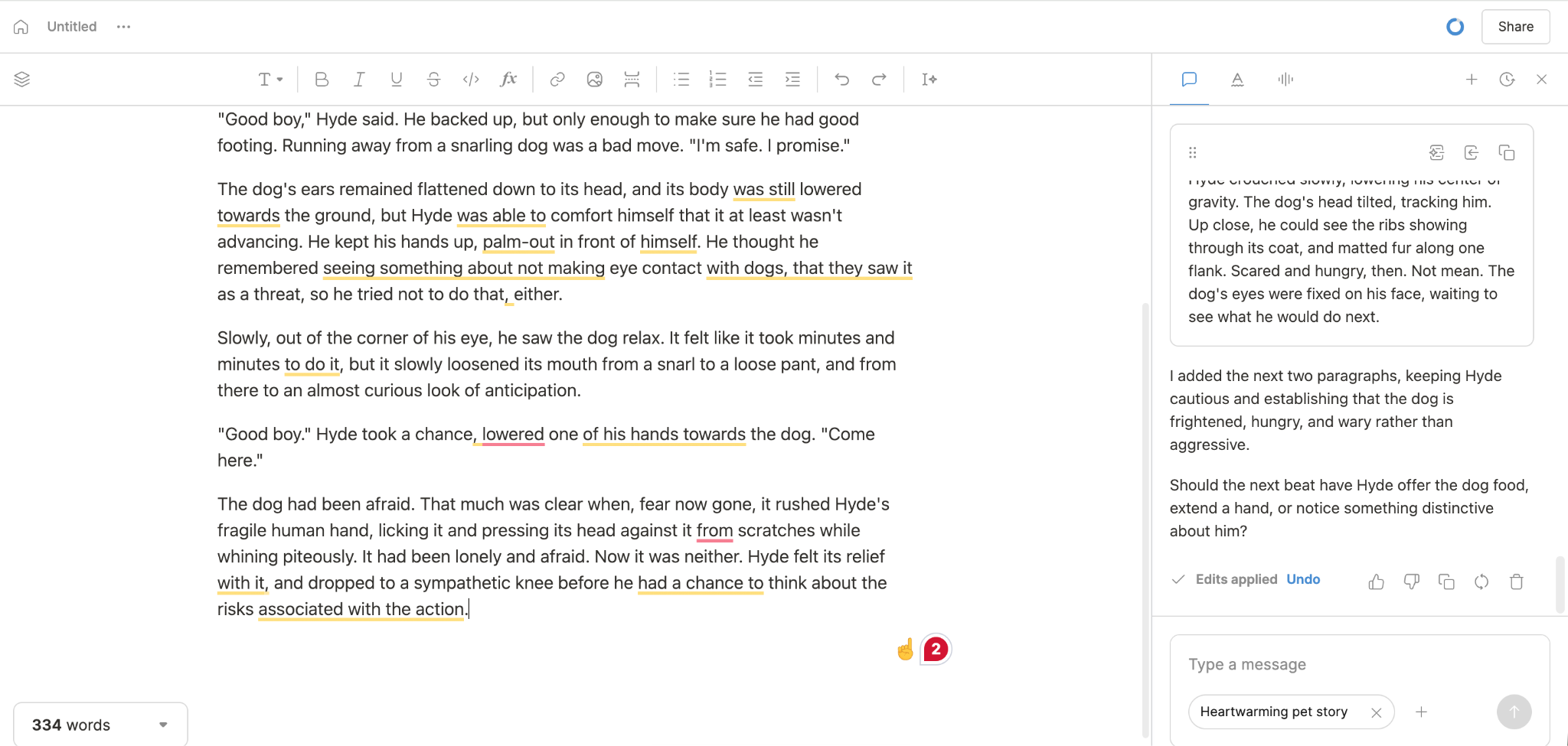
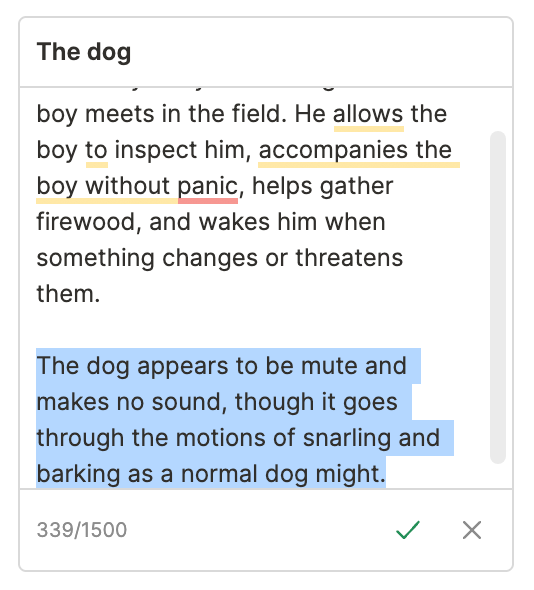
And that’s something that the author can live with. Keep in mind, too, that the interface has been working behind the scenes the whole time, updating notes and keeping the story straight. We can actually leverage that for some kinds of changes, if we want, by actually making a manual change to the “Dog” character entry:
And we can tell the chat assistant to take that change into account, rippling the alteration to the dog character throughout the story so far.
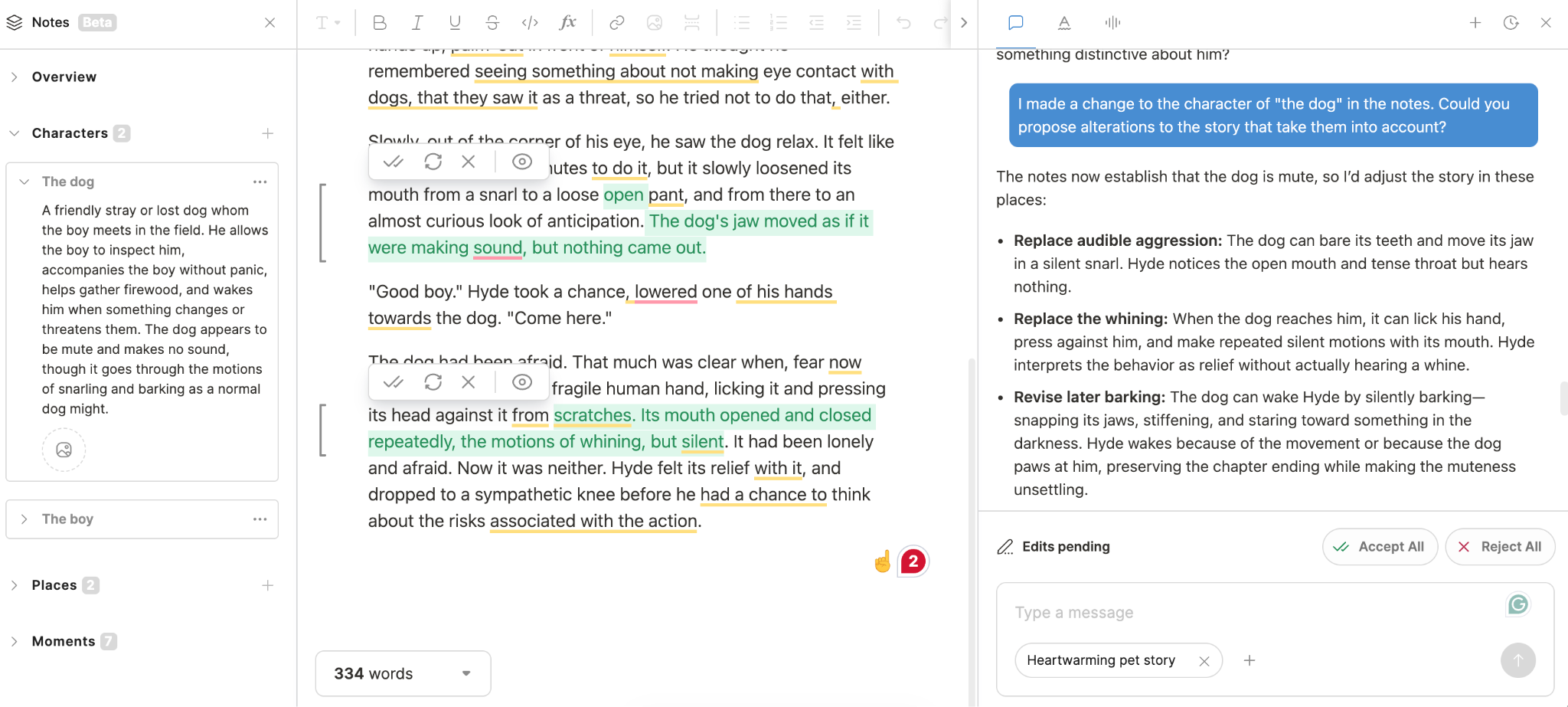
Those changes aren’t necessarily perfect, but they give us a highlighted, fix-these-sections reference to use in making sure our story is consistent with our new notes.
This is the real magic of Type.ai: Every one of the actions we took feels like part of the same process. Because the document is always front-and-center and the focus is always on the work, writing and editing are part of the same fluid process. So is going to the chat box for brainstorming or proposing new paragraphs. When you use the Shorten and Lengthen functions to fine-tune a sentence and the paragraph around it, it doesn’t feel like you’ve stopped creating, because you haven’t.
The only difference between what was done here and creating a new novel is length. We could have just as easily created fifty outlined chapters as four, and kept writing and editing until the novel was done. We’d never be out of the loop, but we’d never be lacking for help and tools to improve our work and move it forward. In other words, Type changed what could have been a night of just staring at the screen to pure productivity, and made the long-shot possibility of a finished novel just a matter of time.
Writing fiction vs nonfiction with AI
Creating Novels and Fiction
Many of Type.ai’s tools are built with the novelist in mind. Primarily, Type is designed to be a frictionless helper, bolstering your own effort to accelerate your writing. That means tools that are meant to help you maintain continuity between characters that also inform the AI when you let it propose edits or write a paragraph here and there.
It also helps with structure, automatically separating out chapters into moments you can reference to find the exact part of your book you want to work on, at a glance:
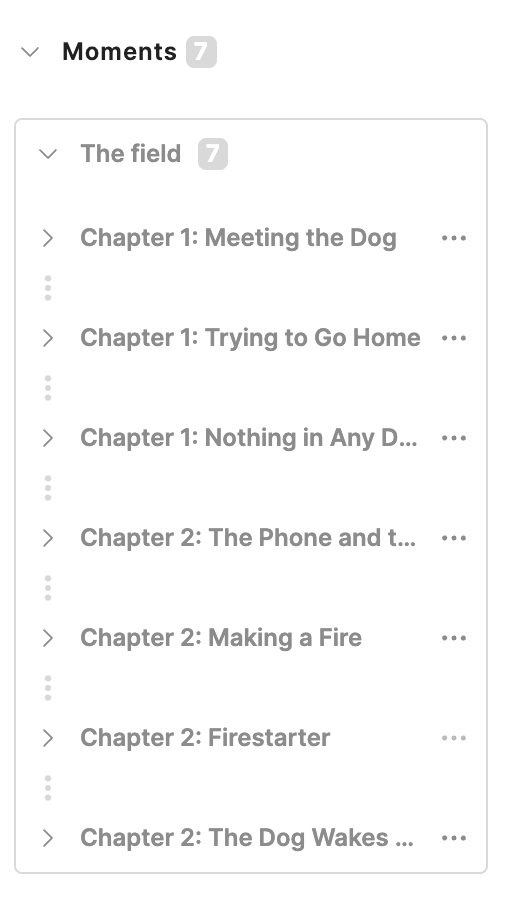
As much functionality as there is here, it’s surprising how little it gets in the way. Other AI writing tools have busier designs that seem to assume that you’ll eventually take yourself out of the process, controlling the AI but not contributing as a writer does. Type.ai never does this. Every tool is right where you expect it to be, giving an experience more like a word processor on steroids, acting as a perfect helper to get you writing faster and better than you could alone.
Non-fiction in Type.ai
As much as Type.ai is built around novels and fiction, it does a wonderful job with non-fiction as well. Most AI writing tools assume the only kind of writing that anyone will do will be different forms of fiction and leave the business book, how-to, and blog authors out to dry.
Right now, the standard interface of Type works just fine for non-fiction, and the current organizational tools that are named for fiction functions assume a new purpose for reality-based writing that is just as useful, if not more so:
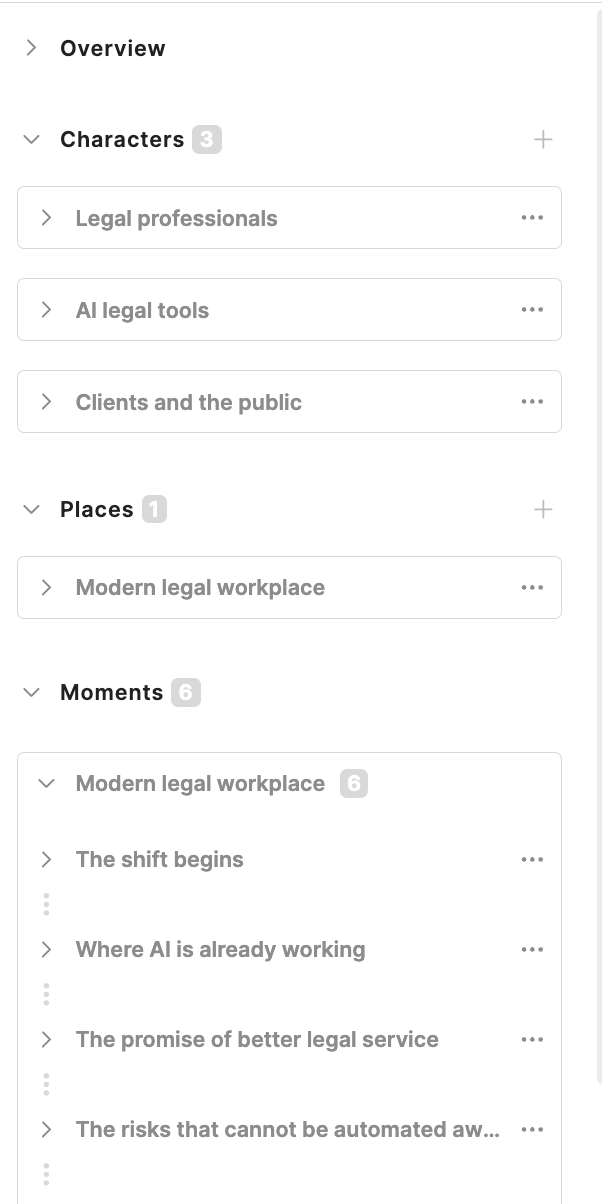
Changes to that interface to make the naming conventions auto-toggle to more non-fiction-appropriate titles when non-fiction projects are detected are in the works, but even now the tooling works just fine. In fact, AI is so well-suited to a more structured, less flowery kind of language that it arguably works better for the purpose.
What AI book writing gets wrong
You might be asking yourself why we emphasize the human connection to the writing so much here. After all, isn’t AI very good at writing? Shouldn’t it be the case that all this human work is just unnecessary?
We can’t speak definitively to what should be, but we can talk about what is or isn’t so at the moment. The harsh truth is that AI writing as it is produced today is simply not up to the challenge of longer work. Due to collapsing context windows (and, sometimes, just misunderstanding the task), AI gets repetitive and cliched at scale, especially when not watched and corrected. Even in the best of times, 100% AI-drafted work sounds just like everyone else's AI-prompted prose, and audiences are fast becoming exhausted with the omnipresent AI voice.
In non-fiction, the same things are true. Worse, non-fiction relies on factual truth in a way fiction doesn’t; AI makes confidently wrong claims often enough for this to sometimes be a disaster.
Can you publish an AI-assisted book? (Amazon KDP and disclosure)
Whether or not you have to disclose that you used AI on a book has to do with whether or not Amazon considers it AI-assisted or AI-generated as a matter of policy, and that policy is (unfortunately) fairly vague on the exact location of the line between the two categories:
- AI-generated: We define AI-generated content as text, images, or translations created by an AI-based tool. If you used an AI-based tool to create the actual content (whether text, images, or translations), it is considered "AI-generated," even if you applied substantial edits afterwards.
- AI-assisted: If you created the content yourself, and used AI-based tools to edit, refine, error-check, or otherwise improve that content (whether text or images), then it is considered "AI-assisted" and not “AI-generated.” Similarly, if you used an AI-based tool to brainstorm and generate ideas, but ultimately created the text or images yourself, this is also considered "AI-assisted" and not “AI-generated.” It is not necessary to inform us of the use of such tools or processes.
Something like mere spell-check and grammar check seems clearly within the bounds of “AI-assisted”, and something like a fully-generated novel made from a single prompt is fairly obviously AI-generated. Our best interpretation of the gray area has to do with how a work began its life; if a paragraph was generated with AI then edited, it’s generated. If you wrote it and refined it with AI, it’s not.
This is good news for the workflow we went over above. If you are OK with an AI-generated disclosure, you can use the AI generative abilities of Type.ai as much as you like - it’s just about being honest, after the fact, that you did.
If you want to avoid that, Type gives you your best path forward; it lets you refine and edit your human-created words as quickly and well as any option out there. Of course, the situation on the ground is constantly changing; different publishers have different policies, and even those are changing every day. But for a person aiming for AI-edited work, Type allows as light a touch as you feel necessary, while still giving as much benefit as possible.
AI book writer vs hiring a ghostwriter
What makes more sense in terms of hiring a ghostwriter or using an AI tool to either generate writing or take your own writing to the next level? We’ve considered cost, timeline, voice concerns, and ownership in the table below. As a quick spoiler, AI-assisted writing wins hands down; you keep authorship and make your own choices, with expected costs of fractions of a percent of what you might have spent hiring the work out.
Other AI book-writing tools worth knowing
Sudowrite: A very good tool for those who want to lean into AI-generation. Sudowrite presents a busy but tool-rich method of turning brainstorming into AI-generated prose. It’s nice for writers who want to have mostly AI-generated text with less human editing and involvement.
ChatGPT/Claude/Other Chatbots: Powerful, versatile tools but unspecialized for the task of writing. The top-end chatbots are the most powerful tools on the market, but lack the specialization other writer-specific tools provide. They are good for light writing work, or any non-writing task.
NovelCrafter: NovelCrafter is great for techy authors who want to control their AI model choices by bringing their own API keys and separately purchased tokens for use in a stand-alone tool. For normal authors who don’t have a specific reason to use it, NovelCrafter often doesn’t provide enough benefits to counterbalance the extra setup steps.
Scrivener + AI plugins: Scrivener is an excellent tool made for general writing organization that can be integrated with AI. It’s best suited for writers who want organization tools, but don’t necessarily need them to be centered around AI-powered efficiency.
Frequently asked questions
1. Can AI write an entire book?
It can, but fully AI-generated books still lag behind in terms of quality and audience acceptance. Human creativity is still a required part of creating worthwhile writing.
2. What is the best AI book writer? (Type.ai answer with honest qualification)
Type.ai is, generally speaking, the best tool for serious, efficient human writing. Sudowrite and NovelCrafter are great alternatives for writers with specific needs, however.
3. How long does it take to write a book with AI?
It depends on how much human involvement is used. A fully AI-generated book can be made in a matter of minutes or hours, but generally won’t be very good. A human can use AI to speed their own writing process and cut the time it takes to make a book from years to weeks or months with little quality loss, however.
4. Will my AI-assisted book sound like AI wrote it?
It depends on how much of it AI writes. If you use the AI functions of Type.ai wisely, it’s possible to get all the speed and efficiency benefits they promise without giving up your voice. Your involvement in the process is key, though - you get out what you put in. Ultimately, your human judgement is still necessary; if your output sounds like AI to you, it will to other people and probably needs more editing.
5. Can I publish an AI-assisted book on Amazon KDP? (policy-verified answer)
6. Can AI write nonfiction books?
It can! Type.ai is just as good at non-fiction as fiction, and arguably even better.
7. How much does it cost to write a book with AI?
Type.ai’s basic tier is available at $12 a month, or $8 a month when billed annually. A free limited tier is available for light use, and Pro and Max subscriptions are designed to fit the needs of heavy users who need the additional token budget.
8. Is writing a book with AI cheating? (direct, non-defensive answer)
It can be. Whether or not a person can be considered an author if an AI wrote an entire book from a prompt is a hard one, but most people consider it different from truly writing a piece. Type.ai favors an approach in which writers are a bigger part of their own work than that, and has built a tool to help them be effective.
9. Can AI keep characters and plot consistent across a whole book?
It can, but issues with AI models keeping facts straight over large context windows (i.e high word counts) mean that specialized tools like Type.ai are often necessary to allow them to keep track of details.
10. Who owns the copyright to an AI-assisted book?
This is a complex question without a clear, settled answer, but we find that this article is an excellent starting place. Type.ai does not claim ownership over works users make with its tools.
Type.ai is the most powerful tool for realizing your own writing dreams in your own voice.